
On this page
- Quick answer: the best Toggl alternatives
- What Toggl is in 2027
- Why agencies look for Toggl alternatives
- First decide which job you are replacing Toggl for
- How to choose a Toggl alternative for a marketing agency
- Toggl alternatives compared
- The 8 best Toggl alternatives in 2027
- 1. Verbial
- 2. Harvest
- 3. Clockify
- 4. Everhour
- 5. Timely
- 6. Productive
- 7. Teamwork.com
- 8. Scoro
- How the options score for agencies
- A worked example: timer view vs margin view
- When Toggl is still the right choice
- How to switch from Toggl without losing a billing cycle
- The bottom line
- Common questions
Toggl Track is a strong timer, but it exports billable hours rather than invoicing them and does not know what each client pays. Decide whether you need a better timer (Clockify, Harvest, Everhour, Timely), time plus delivery (Productive, Teamwork.com, Scoro) or a system that ties hours, retainers, invoices and client margin together (Verbial), then switch over one billing cycle.
Toggl Track is the timer a lot of marketing agencies start with, and for good reason: it is quick to set up, people actually use it, and the free plan covers a small team. The search for Toggl alternatives usually starts a few years later. The agency now sells monthly retainers, hourly overages and one-off projects to the same client, leadership wants margin by client rather than hours by project, and finance is still exporting billable hours to build invoices somewhere else.
This guide is for owners and operations leads at marketing agencies with roughly 10 to 200 people. It covers why agencies outgrow Toggl and how eight alternatives compare on invoicing, retainers, client margin and switching. Vendor details come from each company's own website as of November 2026, so check them again before you buy.
Quick answer: the best Toggl alternatives
- Verbial: best for marketing agencies that want time tracking, retainers, invoicing and client margin in one system, built around how agencies bill.
- Harvest: best for teams that want a familiar timer with invoicing built in and accounting integrations.
- Clockify: best for agencies that need the lowest cost per seat for time tracking, approvals and simple invoicing.
- Everhour: best for teams that want timers inside Asana, ClickUp or Jira, with budgets and invoicing.
- Timely: best for teams that would rather capture time automatically than start and stop timers.
- Productive: best for agencies that want delivery, budgets, resource planning and a CRM in one platform.
- Teamwork.com: best for project-led client teams that want time budgets and retainers inside their project plans.
- Scoro: best for larger multi-service firms that want to assemble a professional services platform app by app.
What Toggl is in 2027
Toggl started as a pure time tracker and is widening its scope. Its pricing page now describes "the time tracking teams love, now with capacity management and project planning", and notes that Toggl Track and Toggl Plan both remain available for existing users. The current plans look like this:
- Free: manual and real-time timers, simple planning and personal reports, for a limited number of users.
- Starter: listed at $9 per user a month billed annually, or $12 monthly. It adds billable rates and team-level revenue reports.
- Premium: listed at $16 per user a month billed annually, or $24 monthly. It adds labor costs and profitability reports, fixed fee projects, project dashboards and timesheet approvals.
- Enterprise: priced through sales, with onboarding and custom access levels.
Capacity management is a separate add-on, and so is time off management. On its agency use case, Toggl lists billable rates, revenue and profitability reports, and recurring projects for retainer clients.
Why agencies look for Toggl alternatives
The timer is rarely the problem. Agencies move on because of everything around it.
- The invoice is built somewhere else. Toggl's invoicing page describes using tracked billable hours as the basis for your invoices and exporting them as CSV or PDF. That export step is where billable time gets lost or keyed in twice.
- Retainers are not hours. A $10,000 monthly retainer is sold as a fixed fee, often split across departments. A time tracker can show hours against an estimate, but it does not know what the client is paying for this month, so it cannot warn you that the retainer is running hot with ten days left. That is the idea behind retainer burn rate.
- Profit needs real costs. Labor costs and profitability reports sit on Toggl's Premium plan. Even then, margin is calculated from rates someone typed in. Agencies end up rebuilding client profitability in a spreadsheet each month, with ad spend and other pass-through costs handled by hand.
- The commercial side is missing. Toggl does not list a CRM pipeline or proposals among its features, so the deal that set the scope, the hours that delivered it and the invoice that billed it live in three different tools.
First decide which job you are replacing Toggl for
Most "Toggl alternatives" lists mix three different kinds of product, so decide which job you need done first.
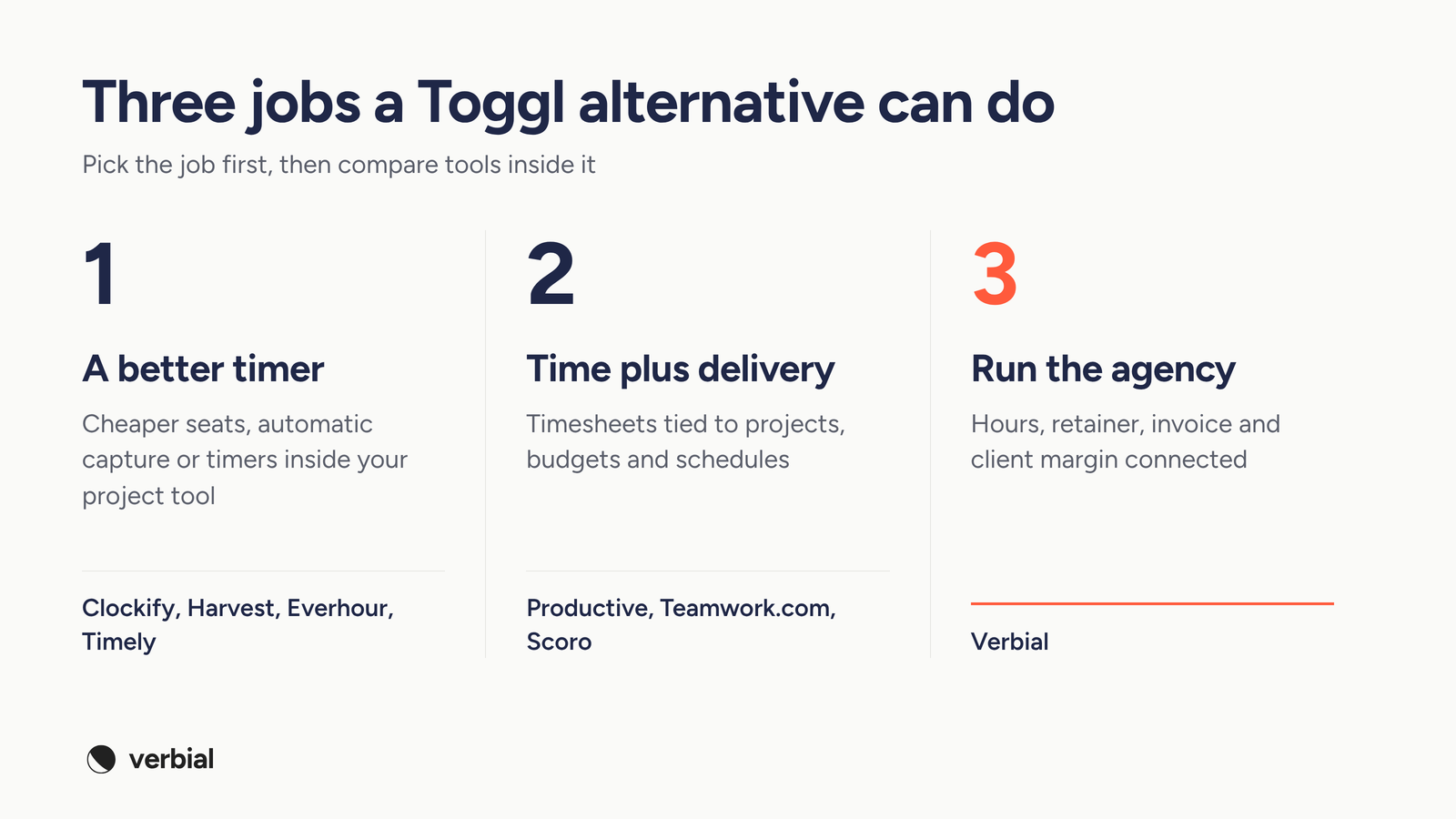
- A better timer. You like Toggl's scope and want cheaper seats, automatic capture or timers inside your project tool. Look at Clockify, Harvest, Everhour and Timely. Expect to keep your CRM, proposal tool and spreadsheet margin model.
- Time plus delivery. You want timesheets tied to projects, budgets and schedules, so the delivery team plans and logs in one place. Look at Productive, Teamwork.com and Scoro.
- Run the agency. You want the deal, the hours, the invoice and the margin for each client connected, so nobody rebuilds the month in a spreadsheet. Look at Verbial.
A quick test: write down the last five questions leadership asked about a client. If they were "who logged what last week", you need a better timer. If they were "are we over the retainer, did that invoice go out and are we making money on this account", you need the third category.
How to choose a Toggl alternative for a marketing agency
Score each option on the places where agency work differs from generic time tracking.
- From hours to invoice. Do approved hours become invoice lines directly, or do you export a report and rebuild it?
- Billing models. Can one client have a monthly retainer, hourly overages, a one-off project and pass-through ad spend, and can you change the terms mid-engagement?
- Retainer pacing. Can you see burn against what the client pays this month while the month is still running?
- Real margin. Does the tool use what each person actually costs, or a rate you type in? Does it keep media spend out of agency revenue?
- Who needs a full seat. Many agencies have designers, writers and freelancers who only ever log time. Check how each vendor handles those people, and whether there is a minimum number of seats.
- Migration. Can you bring your Toggl history across, preview it and undo it if it is wrong? Our migration checklist lists what to export first.
Toggl alternatives compared
The table summarises what each vendor lists on its own site. Prices are the lowest paid plan per user a month, billed annually, unless noted.
| Tool | Price as listed | Invoicing | Client margin | Retainers |
|---|---|---|---|---|
| Toggl Track | Free plan; Starter $9/user/mo | Export billable hours as CSV or PDF | Profitability reports on Premium | Recurring projects |
| Verbial | See the pricing page | Approved hours become invoice lines | By client, project, department and person | Allocation by department, early overrun warning |
| Harvest | Free for 1 seat; Teams $9/seat/mo | Built in, plus Stripe, QuickBooks and Xero | Profitability reports on Enterprise | Project budgets |
| Clockify | Free plan; Basic $3.99/seat/mo | Standard plan and up | Labor cost and profit on Pro | Not listed |
| Everhour | Free up to 5 seats; Team $8.50/seat/mo, 5-seat minimum | Included on Team | Budgets with alerts | Not listed |
| Timely | Starter $9/user/mo, up to 5 users | Bill from logged time | Budgets and costs on Premium | Not listed |
| Productive | Per user, 3-seat minimum | Included | Budgeting and profitability | Recurring budgets on Professional |
| Teamwork.com | Basics $9.99/user/mo | Invoices from logged time on Accelerate | Profitability insights on Optimize (sales-priced) | Time budgets and retainers on Accelerate |
| Scoro | From €15/user/mo, 5-user minimum | Invoice app | Margin report | Retainer management in Deliver |
The 8 best Toggl alternatives in 2027
1. Verbial
Verbial is comprehensive agency management software built for marketing agencies. It connects the CRM pipeline, proposals, time tracking, invoicing, client reporting and profitability, so every client shows its real margin while the month is still running.
The difference from Toggl is where an hour goes after it is logged. In Verbial, time is logged with a timer or a quick entry, tagged to the right client and department, and approved weekly, with periods locked after 30 days. Each hour is measured against the client's monthly allocation by department, and you get a warning before a client's allocation runs out, while there are still days left in the month. With invoicing, approved hours become invoice lines for hourly clients and usage statements for retainers, so there is no export step. The profitability view measures each client against what it pays and what your team actually costs, reports idle capacity on its own line and keeps media pass-through out of revenue.
- Best for: marketing agencies that want to replace Toggl and the spreadsheets around it, rather than swap one timer for another.
- Switching: the Toggl Track import brings clients, projects, tasks and time entries across by API token or from Toggl's Detailed report CSV. Durations are kept to the second, tags and billable flags come across, and people are matched by email. You see a preview before anything is written and can undo the whole import.
- Plans: contributor seats cover people who only track time against assigned work, and clients view shared items free with no login. See the Verbial pricing page for current plans and what each includes.
2. Harvest
Harvest pairs a simple timer with invoicing and expense tracking. The Teams plan is listed at $9 per seat a month billed annually, or $11 monthly, and integrates with Stripe, QuickBooks Online and Xero. Profitability reporting by client, project, task or team and timesheet approvals sit on the Enterprise plan, listed at $14 per seat billed annually.
- Best for: teams that like Toggl's simplicity but want invoicing inside the same tool.
- Watch out for: Harvest says that as your team grows, additional invoices, projects, clients and tasks are billed based on what you use. Resource scheduling is a separate product, Harvest Forecast. Our Harvest alternatives guide covers where agencies outgrow it.
3. Clockify
Clockify is the low-cost option. Basic is listed at $3.99 per seat a month billed annually. Standard, at $5.49, adds invoicing from tracked time, recurring invoices, timesheet approvals, locked timesheets and a QuickBooks integration. Pro, at $7.99, adds scheduling, forecasting, budgets and estimates, and labor cost and profit reports.
- Best for: agencies that want approvals and simple invoicing at the lowest cost per seat.
- Watch out for: every active or invited user on the team page takes a paid seat, and retainer billing is not listed among its features, so fixed-fee clients still need a workaround.
4. Everhour
Everhour puts timers inside the tools your team already uses, including Asana, ClickUp, Jira, Linear, monday.com and Notion. Its Team plan is listed at $8.50 per seat a month billed yearly, with every feature included: integrations, budgets with alerts, invoicing and expenses. A limited free plan covers up to 5 seats.
- Best for: agencies whose delivery team lives in a project management tool and does not want another app.
- Watch out for: the Team plan has a minimum of 5 seats, and margin depends on how well your project tool's structure matches the way each client is billed.
5. Timely
Timely tracks time automatically from the apps and websites people use and uses AI to categorise it, so nobody starts or stops a timer. Starter is listed at $9 per user a month billed yearly, capped at 5 users and 20 projects. Premium, at $16, raises the cap to 50 users and adds budgets, costs and accounting integrations, and Unlimited, at $22, adds capacity management.
- Best for: teams where the real problem is that people forget to log time at all.
- Watch out for: automatic capture still needs someone to review and assign the hours, and user caps on the lower plans mean a growing agency will move up a tier quickly.
6. Productive
Productive is an agency operations platform covering projects, budgeting and profitability, resource planning, time tracking, invoicing and a sales CRM. Its Professional plan adds recurring budgets, billable time approvals and rate cards, and the top Ultimate plan is "Let's talk".
- Best for: agencies whose main pain is delivery planning and budgets across many projects.
- Watch out for: every plan requires at least 3 seats, and freelancers and contractors are charged the same price as employees. We compare the two approaches to client profitability in Productive vs Verbial.
7. Teamwork.com
Teamwork.com is project management built for client-service teams. Basics is listed at $9.99 per user a month billed yearly. Accelerate, at $24.99, adds workload and live capacity planning, time budgets and retainers, invoices created from logged time, and HubSpot and QuickBooks connections. Quotes, the CRM pipeline and revenue, cost and profitability insights sit on Optimize, which is priced through sales.
- Best for: teams that plan everything in projects and want time and retainers inside that plan.
- Watch out for: the commercial side, from quote to profitability, is on the sales-priced tier. See our Teamwork comparison.
8. Scoro
Scoro is a professional services platform made of eight apps, including Track for time and labor cost and Invoice for billing. Its Time-billing combination pairs the two, and combinations start from €15 per user a month. The Deliver app includes retainer management.
- Best for: larger agencies and multi-service firms that want quoting, delivery, resourcing and billing in one platform and have someone to own the setup.
- Watch out for: the minimum is 5 users on every combination, so price the full set of apps you need. Our Scoro comparison goes further.
How the options score for agencies
The matrix scores each option on the four things agencies usually weigh against Toggl. A full mark means it is part of the product, a half mark means it is partial, an export or only on a higher or sales-priced tier, and an empty mark means you will need another tool.
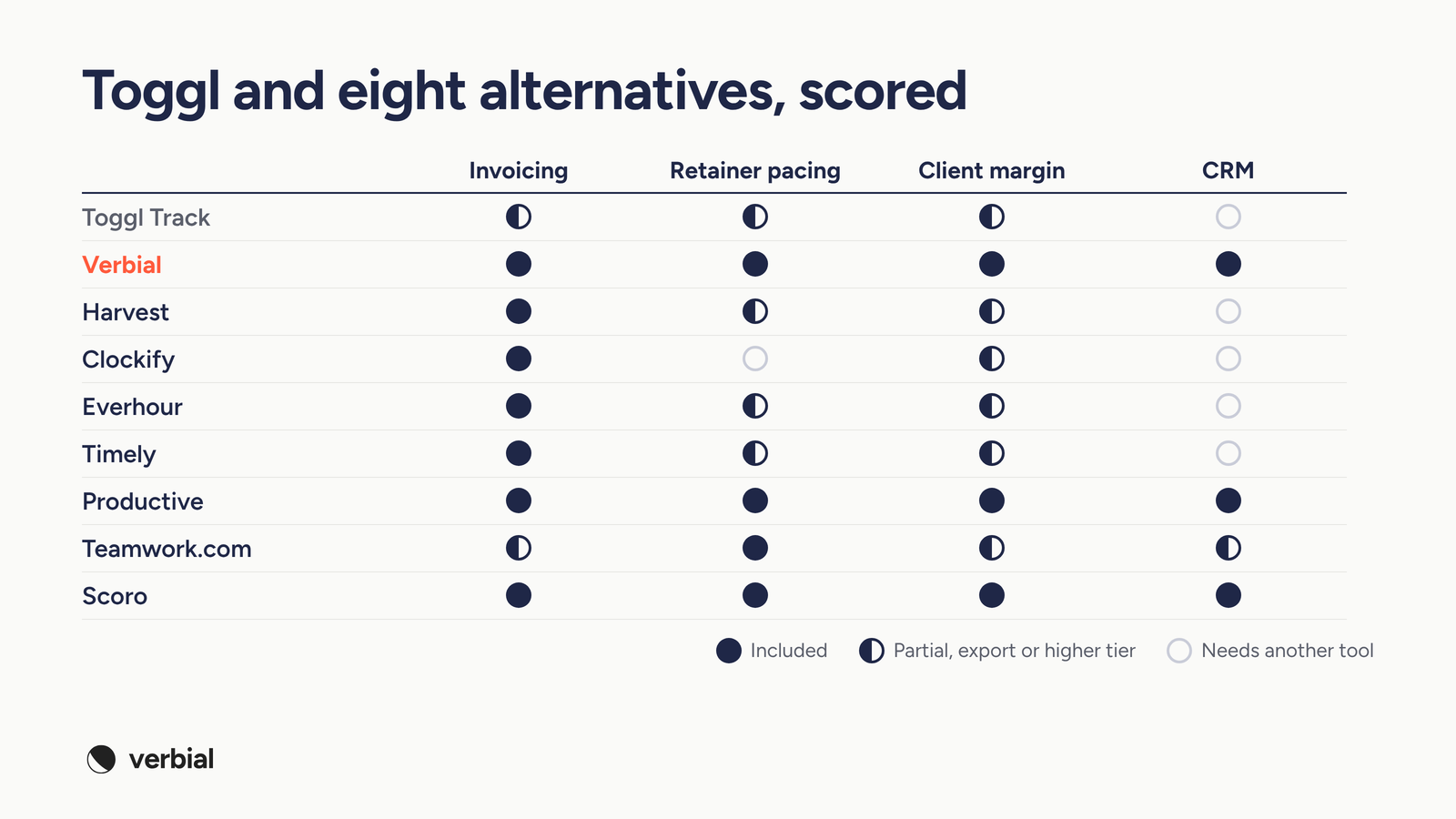
The timers (Harvest, Clockify, Everhour and Timely) close Toggl's invoicing gap but leave retainers, margin and the pipeline where they were. The platforms (Productive, Teamwork.com and Scoro) cover more ground but bring seat minimums or sales-priced tiers. Verbial is built around how marketing agencies bill, so it measures every hour against the client's allocation rather than a project estimate.
A worked example: timer view vs margin view
Take a hypothetical client on a $10,000 monthly content and SEO retainer, budgeted at 80 hours across content and SEO, with $6,000 of ad spend re-billed each month. By the 18th, the team has logged 70 hours.
A timer view tells you that 70 hours were logged, which people logged them and that 64 of them were billable. A margin view shows the retainer at about 88% used with 12 days to go, which department is over its share, the cost of those hours at what the people actually earn, and the margin on the $10,000 fee alone, with the $6,000 of ad spend kept out of revenue. Most agencies need the second view every week, which is why our guide to time tracking for retainer pacing argues for pacing the retainer rather than policing the team.
When Toggl is still the right choice
Toggl is a good product, and there are cases where it is the better fit.
- You are under 10 people, bill mostly hourly and are happy to build invoices in your accounting tool.
- Your agency already runs on a separate PSA or ERP and only needs a fast timer that feeds it.
Otherwise, the export step and the monthly spreadsheet usually cost more than the timer saves. Our post on time tracking that agency teams actually do covers the habits that make any tool stick.
How to switch from Toggl without losing a billing cycle
The safest switch runs alongside one billing cycle. Pick a start date just after an invoice run, so the first invoices from the new tool are a full month later.
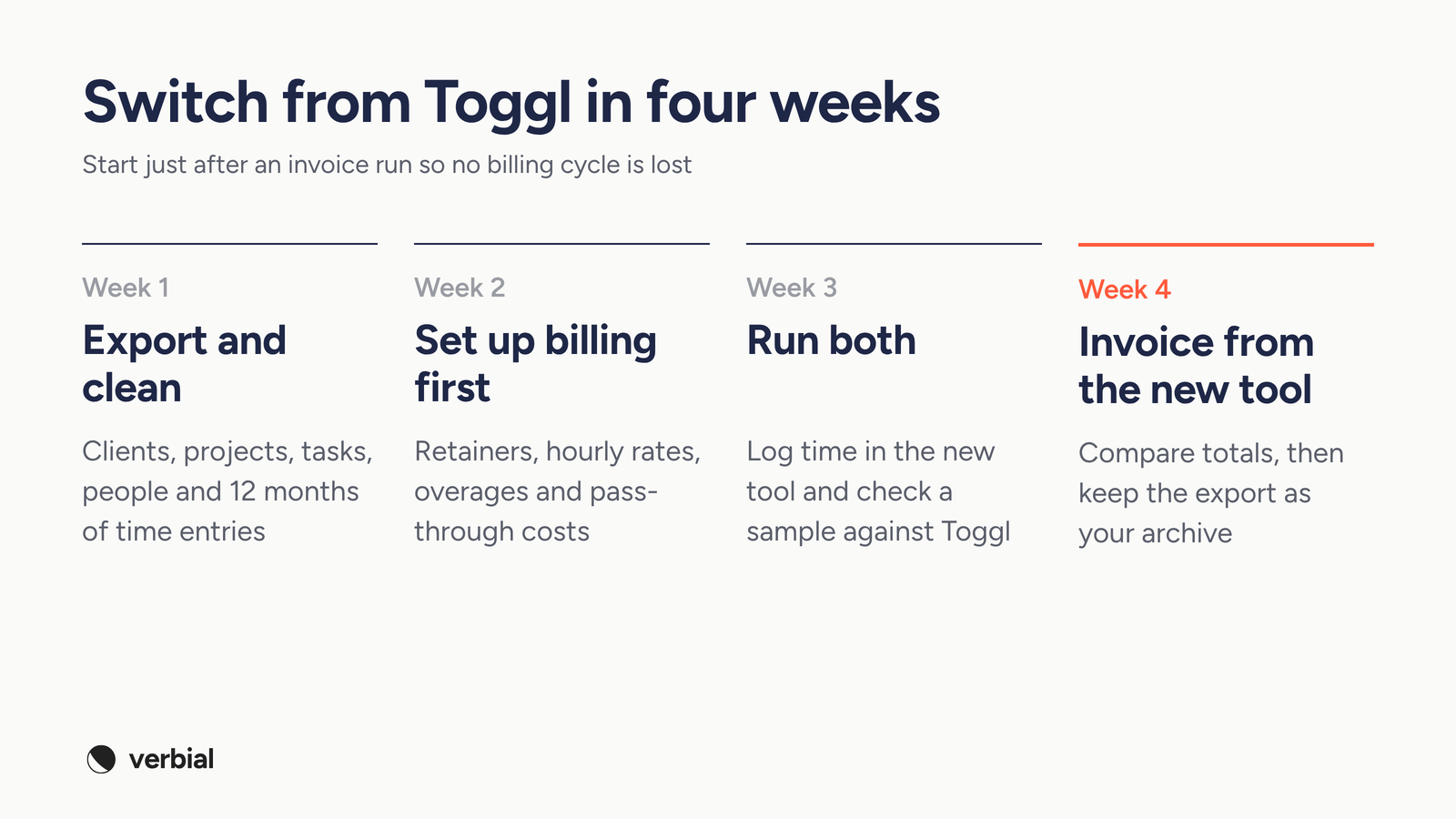
- Week 1: export and clean. Export clients, projects, tasks, people and at least 12 months of time entries from Toggl's Detailed report. Archive dead projects first.
- Week 2: set up billing first. Recreate each client's billing model, including retainers, hourly rates, overages and pass-through costs, before anyone logs time.
- Week 3: run both. Have the team log time in the new tool while finance checks a sample of entries against Toggl. Fix rates and project mapping now, not on invoice day.
- Week 4: invoice from the new tool. Send the next invoice run from the new system, compare totals with what Toggl would have billed, then keep the export as your archive.
Weighing a heavier platform instead? Our Kantata alternatives guide covers the other end of the market.
The bottom line
The best Toggl alternative depends on why you are leaving. If you only want a cheaper or more automatic timer, Clockify, Everhour, Harvest and Timely are all solid. If you want delivery and budgets in one place, compare Productive, Teamwork.com and Scoro. If the real problem is that the hours, the retainer, the invoice and the margin for each client live in different places, look at agency management software such as Verbial, which connects them so you can see each client's margin while the month is still running.
Common questions
What is the best Toggl alternative for a marketing agency?
It depends on why you are leaving Toggl. For a cheaper or more automatic timer, compare Clockify, Harvest, Everhour and Timely. For delivery, budgets and time in one platform, look at Productive, Teamwork.com or Scoro. If you want each client's hours, retainer, invoice and margin connected, look at agency management software such as Verbial, which is built around how marketing agencies bill.
Is there a free alternative to Toggl?
Yes. Clockify has a free plan, Everhour's free plan covers up to 5 seats with limited features, and Harvest's free plan covers 1 seat and 2 projects. Free plans suit freelancers and very small teams, but agencies usually need paid features such as approvals, invoicing and profitability reports.
How much does Toggl cost?
Toggl lists a Free plan for a limited number of users, Starter at $9 per user a month billed annually ($12 monthly) and Premium at $16 per user a month billed annually ($24 monthly). Enterprise is priced through sales. Capacity management and time off management are paid add-ons. Check toggl.com/pricing for current figures.
Does Toggl do invoicing?
Toggl tracks billable hours and rates, and its invoicing page describes exporting that time as CSV or PDF to use as the basis for your invoices. If you want approved hours to become invoice lines without an export step, you need a tool with invoicing built in, such as Harvest, Clockify, Everhour or Verbial.
Can I move my time data from Toggl to another tool?
Yes. Export clients, projects, tasks, people and time entries from Toggl's Detailed report before you switch. Verbial's Toggl Track import brings clients, projects, tasks and time entries across by API token or from that CSV, keeps durations to the second, matches people by email, and lets you preview the import and undo it.
What is the difference between Toggl and agency management software?
Toggl is built around the timer: it records how long work took and reports on it. Agency management software such as Verbial starts from what each client pays. It measures every hour against the client's monthly allocation, turns approved hours into invoice lines and shows each client's margin against what your team actually costs, alongside the CRM and proposals that sold the work.
Written by Alex Borden. Filed under Operations, Profitability.