
On this page
- Quick answer: the best Hubstaff alternatives
- What Hubstaff is in 2027
- Why agencies look for Hubstaff alternatives
- First decide what you are replacing Hubstaff for
- How to choose a Hubstaff alternative for a marketing agency
- Hubstaff alternatives compared
- The 7 best Hubstaff alternatives in 2027
- 1. Verbial
- 2. Harvest
- 3. Toggl Track
- 4. Clockify
- 5. Timely
- 6. Everhour
- 7. Time Doctor
- How the options score for agencies
- A worked example: the activity report vs the margin view
- When Hubstaff is still the right choice
- How to switch from Hubstaff without losing a billing cycle
- The bottom line
- Common questions
Hubstaff is built to monitor a workforce, so it tells you who was active, not whether a client is profitable. Decide whether you want to keep monitoring (Time Doctor, Clockify), drop it and keep a timer (Toggl Track, Harvest, Timely, Everhour) or tie hours, retainers, invoices and client margin together (Verbial), then switch over one billing cycle.
Hubstaff answers one question very well: was this person working, and on what? Screenshots, activity levels, app and URL tracking and idle detection all serve that question. Marketing agencies usually start looking for Hubstaff alternatives when leadership starts asking a different one: is this client paying for the hours we are putting in?
This guide is for owners and operations leads at marketing agencies with roughly 10 to 200 people. It explains where Hubstaff fits, where it strains for agency work, and compares seven alternatives on invoicing, retainers, client margin and how much monitoring each one does. Vendor details come from each company's own website as of November 2026, so check them again before you buy.
Quick answer: the best Hubstaff alternatives
- Verbial: best for marketing agencies that want time tracking, retainers, invoicing and client margin in one system, built around how agencies bill.
- Harvest: best for teams that want a simple timer with invoicing and accounting integrations, and no screenshots.
- Toggl Track: best for teams that want a polished timer and planning, with a clear no-monitoring stance.
- Clockify: best for teams that want the lowest cost per seat and optional monitoring features.
- Timely: best for teams that want automatic time capture that stays private to each person.
- Everhour: best for teams that want timers inside Asana, ClickUp, Jira or monday.com, with budgets and invoicing.
- Time Doctor: best for teams that want to keep screenshot-style monitoring but with a different set of reports.
What Hubstaff is in 2027
Hubstaff describes itself as a time tracking platform that turns work hours into insights with productivity monitoring and automated payments, and its pricing page says 140k global users trust it. The product is built for managing a workforce: timers and timesheets, activity levels based on keyboard and mouse activity, screenshots, app and URL tracking, idle time, attendance, scheduling, GPS locations for field teams, and payroll. Its solutions menu lists agencies next to remote teams, field crews, call centers, BPOs and virtual assistant services.
Its pricing page lists four plans, each priced per seat a month:
- Starter: listed at $4.99 billed annually, or $7 monthly, with a 2-seat minimum. It includes time tracking, timesheets, activity levels, client invoices, up to 5 clients and 500 screenshots per seat a month.
- Grow: listed at $7.50 billed annually, or $9 monthly, with a 2-seat minimum. It adds project budgets, expenses, one integration and 1,500 screenshots per seat a month.
- Team: listed at $10 billed annually, or $12 monthly, with a 2-seat minimum. It adds timesheet approvals, client budgets, team invoices, full payments and payroll, unlimited screenshots and unlimited integrations.
- Enterprise: listed at $25 per seat, billed annually, with account provisioning and dedicated support.
The pricing FAQ is clear that Hubstaff charges per seat, so everyone who tracks time pays, including the owner. People who only view reports can use a free Project Viewer role.
Why agencies look for Hubstaff alternatives
Hubstaff is a capable product. The friction comes from the gap between managing a workforce and running a client service business.
- Activity is not margin. An activity score tells you that a keyboard and mouse were busy. It cannot tell you that a client's retainer is running hot with ten days left in the month, or that a fixed-fee client is losing money. That is the idea behind retainer burn rate.
- Screenshots change the culture. Strategists, writers and designers think away from the keyboard. A low activity score during a whiteboard session or a client call is noise, and senior hires often read screenshot monitoring as a lack of trust. Agencies compete for that talent.
- The agency features sit on the top plans. Client budgets and timesheet approvals are on Team and above, and Starter caps you at 5 clients. Most agencies with real retainers end up on Team.
- Retainers are not projects. A monthly retainer is a fixed fee, often split across departments, with overages and ad spend on top. Hubstaff tracks project costs from tracked hours, and client budgets arrive on the Team plan, but retainer billing is not among its listed features, so the servicing gap between what a client pays and what it costs stays hidden until renewal.
- The commercial side lives elsewhere. Hubstaff does not list a CRM pipeline or proposals, so the deal that set the scope, the hours that delivered it and the invoice that billed it sit in different tools.
First decide what you are replacing Hubstaff for
Most "Hubstaff alternatives" lists mix monitoring tools with simple timers. Pick the job first.
- Keep monitoring. You value screenshots and activity data, for example for a remote production team, and want a different price or report set. Look at Time Doctor and Clockify.
- Drop monitoring, keep a timer. You want accurate hours without screenshots or activity scores. Look at Toggl Track, Harvest, Timely and Everhour.
- Run the agency. You want the deal, the hours, the retainer, the invoice and the margin for each client connected, so nobody rebuilds the month in a spreadsheet. Look at Verbial.
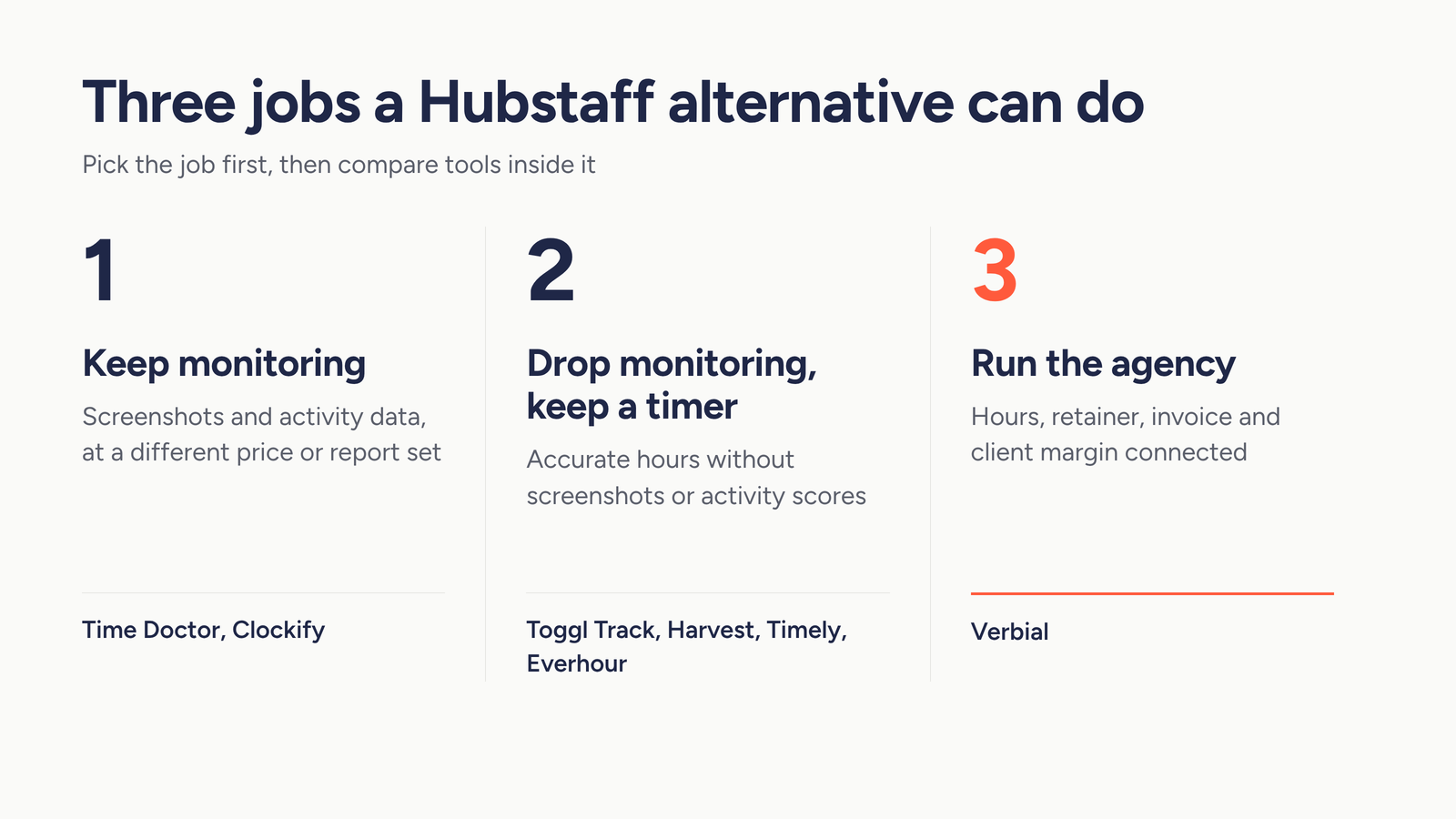
A quick test: if leadership's last five questions were "who was active today", you need a monitoring tool. If they were "are we over the retainer and are we making money on this account", you need the third category.
How to choose a Hubstaff alternative for a marketing agency
Score each option on the places where agency work differs from workforce monitoring.
- From hours to invoice. Do approved hours become invoice lines directly, or do you export a report and rebuild it?
- Billing models. Can one client have a monthly retainer, hourly overages, a one-off project and pass-through ad spend?
- Retainer pacing. Can you see burn against what the client pays this month while the month is still running?
- Real margin. Does the tool use what each person actually costs, or a pay rate you type in? Does it keep media spend out of agency revenue?
- Monitoring level. Decide what your team will accept: screenshots, activity scores, app tracking, or none of them.
- Who needs a full seat. Check how each vendor charges for people who only log time, and whether there is a seat minimum.
Hubstaff alternatives compared
The table summarises what each vendor lists on its own site. Prices are the lowest paid plan per user a month, billed annually, unless noted.
| Tool | Price as listed | Monitoring | Invoicing | Client margin |
|---|---|---|---|---|
| Hubstaff | Starter $4.99/seat/mo, 2-seat minimum | Screenshots, activity levels, app and URL tracking | Client invoices on every plan | Project costs; client budgets on Team |
| Verbial | See the pricing page | None | Approved hours become invoice lines | By client, project, department and person |
| Harvest | Teams $9/seat/mo | None listed | Built in, plus Stripe, QuickBooks and Xero | Profitability reports on Enterprise |
| Toggl Track | Starter $9/user/mo | None: no screenshots or keystrokes | Export billable hours as CSV or PDF | Profitability reports on Premium |
| Clockify | Basic $3.99/seat/mo; free up to 5 users | Activity monitoring on Pro, optional GPS | Standard plan and up | Labor cost and profit on Pro |
| Timely | Starter $9/user/mo, up to 5 users | Private automatic capture | Invoices from logged time | Budgets and costs on Premium |
| Everhour | Team $8.50/seat/mo, 5-seat minimum | None listed | Included on Team | Budgets with alerts |
| Time Doctor | Basic $6.70/user/mo | Screenshots on every plan; web and app usage on Standard | Not listed | No client margin report listed |
The 7 best Hubstaff alternatives in 2027
1. Verbial
Verbial is comprehensive agency management software built for marketing agencies. It connects the CRM pipeline, proposals, time tracking, invoicing, client reporting and profitability, so every client shows its real margin while the month is still running.
The difference from Hubstaff is what an hour is measured against. Hubstaff measures an hour against the person: were they active, what apps were open. Verbial measures it against the client: people log time with a timer or a quick entry, tagged to the right client and department, and timesheets are approved weekly with reminders. Each hour counts against the client's monthly allocation by department, and the account manager gets a warning before the allocation runs out, while there is still time to act. With invoicing, approved hours become invoice lines for hourly clients and usage statements for retainers. The profitability view measures each client against what it pays and what your team actually costs, reports idle capacity on its own line and keeps media pass-through out of revenue.
- Best for: marketing agencies that want to replace Hubstaff and the spreadsheets around it, rather than swap one timer for another.
- Who sees what: members and managers see hours only. Account managers and directors see revenue and budgets, and only admins see margins and salaries.
- Monitoring: none. Verbial tracks time against clients, not screens.
- Plans: contributor seats cover people who only track time against assigned work, and clients view shared items free with no login. See the Verbial pricing page for current plans and what each includes.
2. Harvest
Harvest pairs a simple timer with invoicing and expense tracking. The Teams plan is listed at $9 per seat a month billed annually, or $11 monthly, and integrates with Stripe, QuickBooks Online and Xero. Profitability reporting by client, project, task or team and timesheet approvals sit on the Enterprise plan, listed at $14 per seat billed annually.
- Best for: teams leaving Hubstaff because of monitoring, who want invoicing next to the hours.
- Watch out for: budgets sit on projects, not on each client's monthly fee. Our Harvest alternatives guide covers where agencies outgrow it.
3. Toggl Track
Toggl Track is a polished timer that now comes with capacity management and project planning. Its pricing page states that Toggl does not monitor employees, take screenshots, or record keystrokes, browsing history or location. Starter is listed at $9 per user a month billed annually, or $12 monthly. Premium, at $16 billed annually, adds labor costs and profitability reports, fixed fee projects and timesheet approvals.
- Best for: teams that want the clearest break from monitoring, with a clean timer and planning.
- Watch out for: Toggl's invoicing page describes exporting billable hours as CSV or PDF to build the invoice, so the invoice is still made somewhere else. See our Toggl alternatives guide.
4. Clockify
Clockify is the low-cost option. Basic is listed at $3.99 per seat a month billed annually, Standard at $5.49 adds invoicing and timesheet approvals, and Pro at $7.99 adds labor cost and profit reports, budgets and estimates. The free plan now covers up to 5 users. Clockify also lists activity monitoring on Pro and optional GPS tracking, so it can sit closer to Hubstaff than most timers.
- Best for: cost-conscious teams that want Hubstaff-style options at a lower price per seat.
- Watch out for: every active or invited user takes a paid seat, and retainer billing is not among its listed features. See our Clockify alternatives guide.
5. Timely
Timely captures time automatically from the apps and websites people use, through a memory tracker it describes as private, and drafts timesheets from it. Starter is listed at $9 per user a month billed yearly, capped at 5 users and 20 projects. Premium, at $16, adds budgets and costs, and Unlimited, at $22, adds capacity management.
- Best for: teams that like Hubstaff's automatic capture but not its manager-facing screenshots.
- Watch out for: someone still has to review and assign the captured time, and the user caps push growing agencies up a tier quickly.
6. Everhour
Everhour puts timers inside the tools your team already uses, including Asana, ClickUp, Jira, Linear and monday.com. Its Team plan is listed at $8.50 per seat a month billed yearly, with every feature included: budgets with alerts, invoicing and expenses.
- Best for: agencies whose delivery team lives in a project management tool and does not want another app.
- Watch out for: the Team plan has a 5-seat minimum, and margin depends on how well your project tool's structure matches the way each client is billed.
7. Time Doctor
Time Doctor is the closest like-for-like swap if you want to keep monitoring. Basic is listed at $6.70 per user a month billed annually, or $8 monthly, and includes automatic tracking, screenshots and a timeline report. Standard, at $11.70, adds time approvals, web and app usage, attendance and payroll. Premium, at $16.70, adds benchmarks.
- Best for: remote production teams where monitoring is an accepted part of the job.
- Watch out for: invoicing is not among its listed plan features, so client billing still happens somewhere else.
How the options score for agencies
The matrix scores each option on the four things agencies usually weigh against Hubstaff. A full mark means it is part of the product, a half mark means it is partial or only on a higher tier, and an empty mark means you will need another tool.
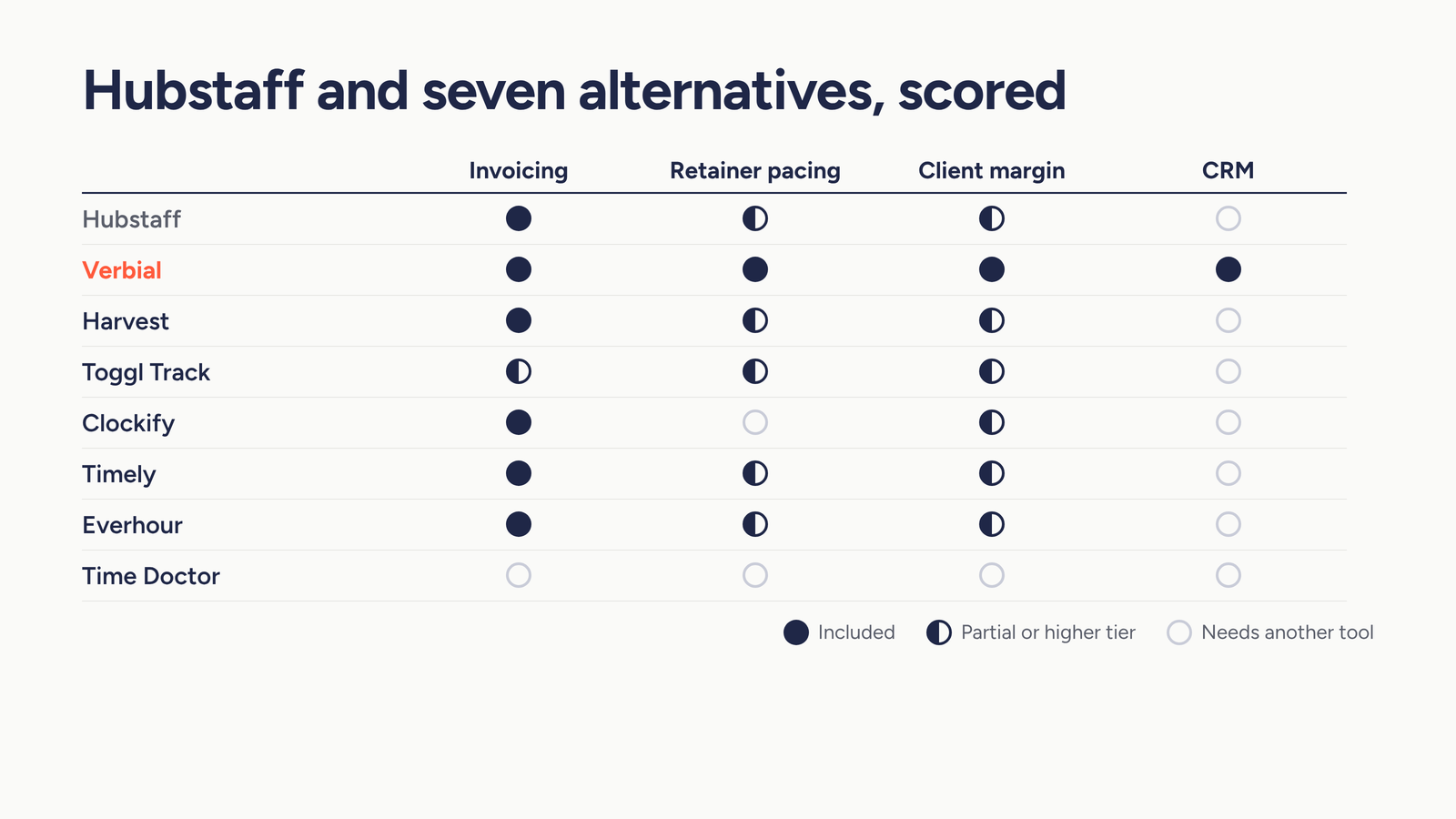
The timers close some of Hubstaff's gaps, mostly a lighter touch on monitoring, but leave retainers, real margin and the pipeline where they were. Verbial measures every hour against the client's allocation rather than a project estimate or an activity score, and it is the only option here with a CRM and proposals in the same system as the hours.
A worked example: the activity report vs the margin view
Take a hypothetical client on a $10,000 monthly retainer for SEO and content, budgeted at 80 hours, with $6,000 of ad spend re-billed each month. By the 21st, the team has logged 74 hours, 18 of them by a freelance writer.
Hubstaff's report would show 74 hours, who logged them, an average activity score, a set of screenshots and a cost built from the pay rates you entered. A margin view shows the retainer at 74 of 80 hours with nine days to go, which department is over its share, the cost of those hours at what the people actually earn, and the margin on the $10,000 fee alone, with the $6,000 of ad spend kept out of revenue. One view says the team was active. The other says call the client about scope this week.
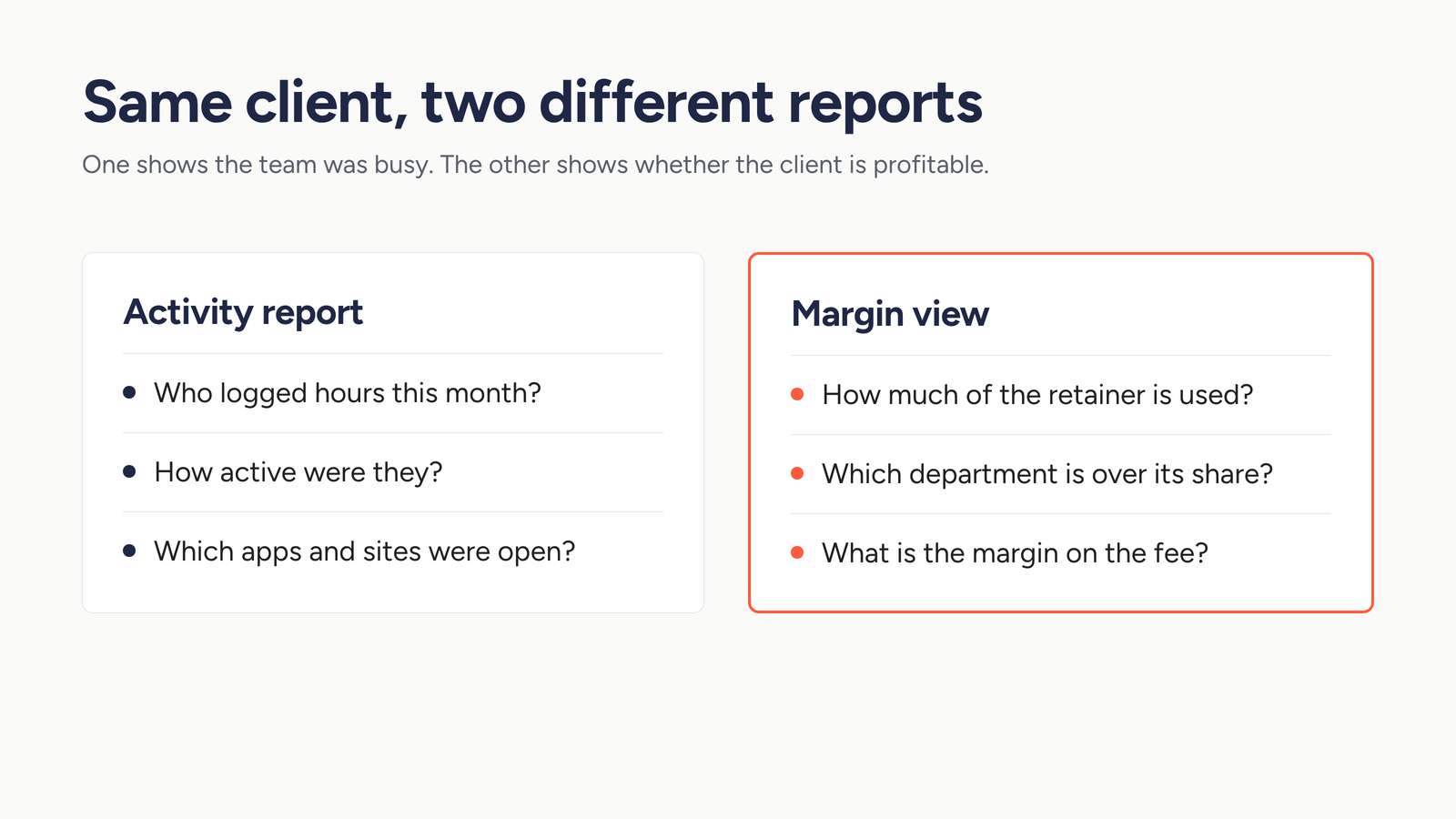
That is why our guide to time tracking for retainer pacing argues for pacing the retainer rather than policing the team.
When Hubstaff is still the right choice
Hubstaff is a strong product, and there are cases where it fits better than any agency tool.
- You run a remote production or outsourcing team where screenshots and activity data are part of the agreement with staff and clients.
- You pay contractors by the hour and want tracked time to flow straight into payroll and global payments.
- You have field staff who need GPS and geofenced clock-ins.
If none of those describe your agency, the screenshots are probably costing more in trust than they return in insight. Our post on time tracking that agency teams actually do covers the habits that get hours logged without monitoring.
How to switch from Hubstaff without losing a billing cycle
Run the switch alongside one billing cycle, starting just after an invoice run.
- Week 1: export and archive. Hubstaff lets you export reports such as Time & Activities and timesheet approvals as CSV or PDF. Export at least 12 months of time by client and project, and keep it as your archive.
- Week 2: set up billing first. Recreate each client's billing model, including retainers, hourly rates, overages and pass-through costs, before anyone logs time. Our migration checklist lists what to set up first.
- Week 3: run both. Have the team log time in the new tool while finance checks a sample of entries against Hubstaff. Tell the team when screenshots and activity tracking will stop.
- Week 4: invoice from the new tool. Send the next invoice run from the new system, compare totals with Hubstaff, then cancel the Hubstaff seats.
The bottom line
The best Hubstaff alternative depends on why you are leaving. If you want to keep monitoring at a different price, compare Time Doctor and Clockify. If you want accurate hours without screenshots, Toggl Track, Harvest, Timely and Everhour are all solid. If the real problem is that the hours, the retainer, the invoice and the margin for each client live in different places, look at agency management software such as Verbial, which measures every hour against what the client pays so you can see each client's margin while the month is still running.
Common questions
What is the best Hubstaff alternative for a marketing agency?
It depends on why you are leaving Hubstaff. To keep screenshots and activity data at a different price, compare Time Doctor and Clockify. To drop monitoring and keep an accurate timer, look at Toggl Track, Harvest, Timely or Everhour. If you want each client's hours, retainer, invoice and margin connected in one system, look at agency management software such as Verbial, which is built around how marketing agencies bill.
Is Hubstaff good for marketing agencies?
Hubstaff works well for remote production teams, contractors paid by the hour and field staff. It strains in agencies that sell retainers, because activity scores do not show whether a client is profitable, client budgets and timesheet approvals sit on the Team plan and above, the Starter plan is capped at 5 clients, and retainer billing is not among its listed features.
Is there a Hubstaff alternative without screenshots?
Yes. Toggl Track states that it does not monitor employees, take screenshots or record keystrokes, browsing history or location. Harvest and Everhour are timers without screenshot monitoring, and Timely captures activity automatically but describes its memory tracker as private to each person. Verbial tracks time against clients rather than screens.
How much does Hubstaff cost?
Hubstaff lists four plans per seat a month: Starter at $4.99 billed annually ($7 monthly), Grow at $7.50 ($9), Team at $10 ($12) and Enterprise at $25, billed annually. Starter, Grow and Team have a 2-seat minimum, and everyone who tracks time needs a paid seat. Check hubstaff.com/pricing for current figures.
Does Hubstaff do invoicing?
Yes. Client invoices are available on every Hubstaff plan, and team invoices, full payments and payroll arrive on the Team plan. What Hubstaff does not list is retainer billing, so fixed monthly fees, pre-paid overages and usage statements still need a workaround.
Can I move my time data from Hubstaff to another tool?
Yes. Hubstaff lets you export reports such as Time & Activities, daily totals and timesheet approvals as CSV or PDF, and some reports in QuickBooks format. Export at least 12 months of time by client and project before you cancel, and keep it as your archive while the new tool takes over from the next billing cycle.
What is the difference between Hubstaff and agency management software?
Hubstaff is built around the worker: how long they worked, how active they were and how they get paid. Agency management software such as Verbial starts from what each client pays. It measures every hour against the client's monthly allocation, turns approved hours into invoice lines and shows each client's margin against what your team actually costs, alongside the CRM and proposals that sold the work.
Written by Alex Borden. Filed under Operations, Profitability.