
On this page
- What is creative project management?
- Why the revision round is the unit of creative work
- The creative project lifecycle in six stages
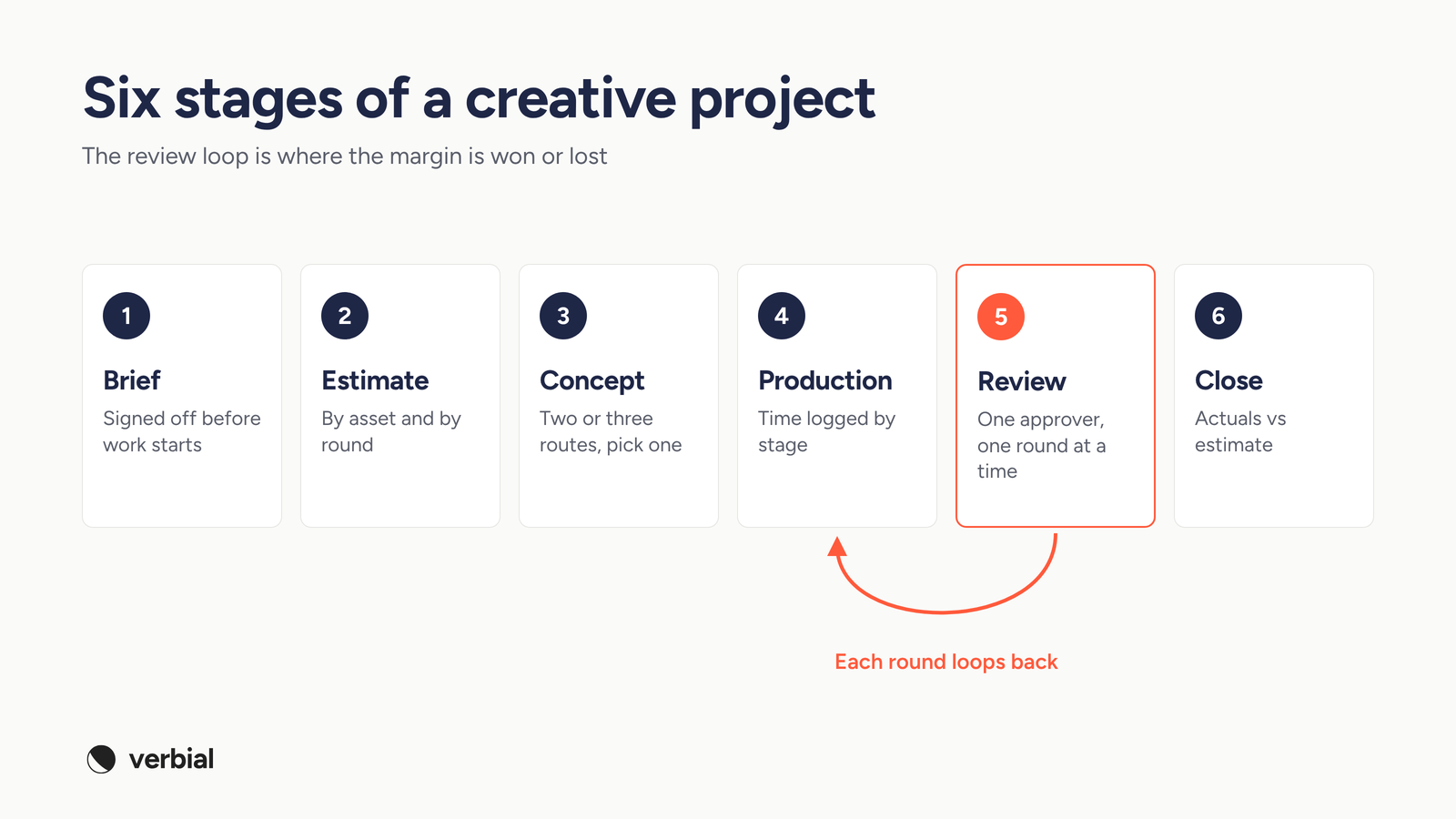
- 1. Brief
- 2. Estimate by asset and round
- 3. Concept
- 4. Production
- 5. Review and approval
- 6. Close and learn
- Five rules that keep creative projects profitable
- The four numbers to watch on every creative project
- Who owns creative project management in a 10 to 200 person agency
- Creative project management software for agencies in 2027
- 1. Verbial
- 2. Ziflow
- 3. Filestage
- 4. Frame.io
- 5. Teamwork.com or Productive.io
- 6. Asana or monday.com
- How to choose
- Common creative project management mistakes
- The short version
- Common questions
Creative project management in an agency is ordinary project management plus control of the review loop. Brief every job, price the included rounds and the next one, take feedback from one named approver, log revision time separately and treat a new direction as new scope. Then review four numbers every week: rounds used, revision share of hours, approval cycle time and estimate vs actual by stage.
It now takes an average of five rounds of creative development to get an idea signed off, according to The BetterIdeas Project, a 2025 study backed by the IPA and the WFA with 1,034 respondents across 54 countries. The same report points back to IPA research from 2007 that put the figure at three. If your proposals still assume two rounds, the math is already working against you.
That gap is where creative project management succeeds or fails. Boards, Gantt charts and stand-ups keep the work moving. They do not tell you that round four on a launch video just ate the margin on the whole job. This guide is for owners and operations leads at creative and marketing agencies with roughly 10 to 200 people. It covers what creative project management is, why the revision round should be your unit of planning, a six-stage lifecycle, five rules that keep rounds under control, the four numbers to watch and the software worth shortlisting in 2027.
What is creative project management?
Creative project management is the practice of planning, producing, reviewing and approving creative work, such as campaigns, video, design and copy, so it lands on brief, on time and at the margin it was sold for. It differs from general project management because the output is judged by people, the plan loops back through revision rounds, and the final say often sits outside your team.
In an agency, three things make it harder than the in-house version:
- The judge is outside the building. The person who approves the work is a client, and often a client's boss you have never met.
- The plan is a loop, not a line. Concept, production and review repeat until someone signs off. A task list has no natural way to show that.
- The cost of a loop is invisible by default. Revision hours look exactly like production hours on a timesheet unless you separate them on purpose.
If you want the broader view of running client projects by billing model, start with our guide to agency project management. This guide zooms in on the part that is unique to creative work: the review loop, and what it does to your hours and your margin.
Why the revision round is the unit of creative work
Tasks are a fine way to organize production. They are a poor way to predict cost on creative jobs, because most of the variance between the estimate and the actual comes from how many times the work goes back and forth. A design task that was "done" on Tuesday can be reopened three times before it ships.
Take a hypothetical launch campaign: a hero video, a key visual and a set of social cutdowns, sold at $18,000. The estimate looks like this:
- Concept: 30 hours
- Production: 50 hours
- Two review rounds at 15 hours each: 30 hours
- Project management and client time: 10 hours
That is 120 hours. At an illustrative fully loaded cost of $75 an hour, delivery costs $9,000 and the job runs at a 50 percent gross margin.
Now let the job take five rounds, the average in the BetterIdeas data. Three extra rounds at 15 hours each add 45 hours. Delivery now costs $12,375 and gross margin falls to about 31 percent. Nothing went wrong on the task board. Every asset shipped and the client is happy. The agency simply gave away more than a third of the profit it planned to make, one "quick tweak" at a time.
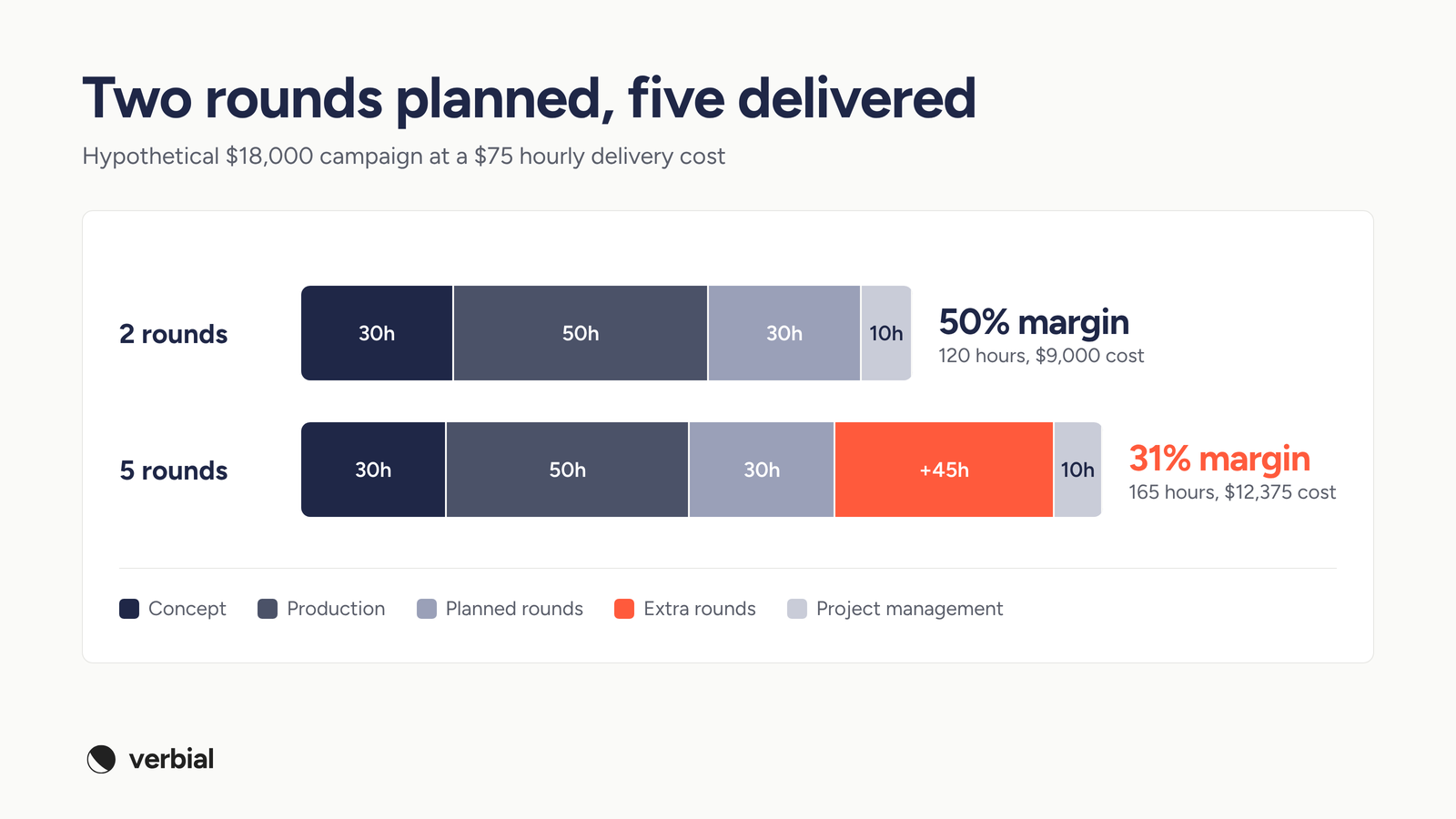
This is why creative project managers in agencies should plan, price and report in rounds. A round is a number the client understands, the team can count and finance can price. Hours are the cost underneath it.
The pattern is not limited to big campaigns. A 2023 survey of 366 creative and marketing professionals by Filestage, reported by MediaPost, found that agency content took 3.3 versions and seven days on average to get approved. In the same survey, 71 percent of respondents said waiting for feedback slowed them down and 63 percent said the same about chasing approvals.
The creative project lifecycle in six stages
Every creative job, from a single landing page to a multi-channel launch, moves through the same six stages. The difference between a profitable studio and a busy one is how deliberately each stage is run.
1. Brief
The brief is the contract for the creative work. It should name the objective, the audience, the mandatory elements, the full list of deliverables with sizes and formats, what is out of scope, the named approver, the number of included rounds and the feedback deadlines. The BetterIdeas study found that only 23 percent of agencies say briefs are always used when ideas are evaluated, which means most feedback is judged against memory and taste. Rule of thumb: no signed-off brief, no start.
2. Estimate by asset and round
Estimate each deliverable type separately, and show rounds as their own line rather than burying them in production. Use your own history: if your last ten social packages averaged 3.4 rounds, do not price the next one at two. A clear agency rate card makes this easier, because the cost of an extra round becomes a line item rather than a negotiation.
3. Concept
Time-box exploration. Present two or three routes, not seven, and ask the client to choose one. Record that choice in writing. Concept sign-off is the most important approval in the job, because any change of direction after it is new scope, not feedback.
4. Production
Production is where conventional project management works well: tasks, owners, due dates and dependencies. The creative-specific habit is to log time against the stage and the asset, so you can later see where the hours went. Check the load against your team before you commit dates, using the same approach as your wider capacity planning.
5. Review and approval
Run an internal review before anything goes to the client. Then treat each client round as one consolidated set of feedback from the named approver, due by an agreed date. This is the stage where agencies struggle most. In the BetterIdeas data, only 30 percent of agencies said clients give clear and constructive feedback, only 23 percent said the approval process works well, and only 43 percent said the right people sign off.
6. Close and learn
When the final files go out, compare rounds and hours against the estimate, stage by stage. Bill any extra rounds that were agreed. Feed the actuals back into your estimating library so the next proposal is more accurate. Our guide to project accounting for marketing agencies covers how to close the numbers properly.
Five rules that keep creative projects profitable
The lifecycle only works if a few rules hold. These are the five that matter most, and the second one is where most of the money is.
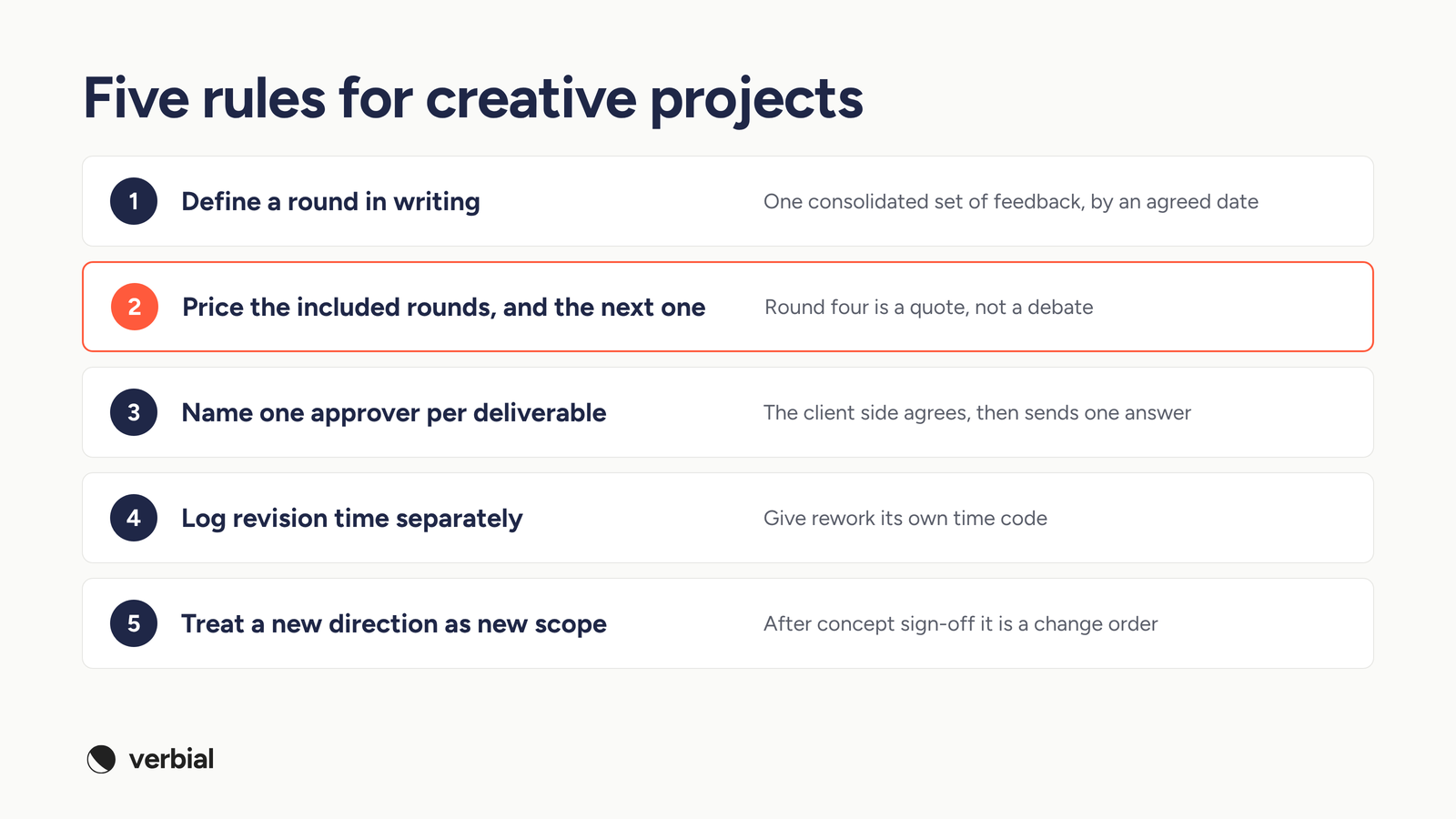
- Define a round in writing. A round is one consolidated set of feedback from the named approver, delivered by an agreed date, against the approved brief. Twelve comments from five people over three days in a chat thread are not five rounds. They are zero rounds until someone consolidates them.
- Price the included rounds, and price the next one. Your proposal should state how many rounds each deliverable includes and what an extra round costs. When the client asks for round four, the answer is a quote, not a debate. Verbial's setup for social and content agencies is built around this idea: extra rounds are quoted and paid for before the team starts on them.
- Name one approver per deliverable. If the client side has a committee, they agree internally and send one answer. This one rule shortens approval cycles more than any tool.
- Log revision time separately. Give revisions their own time code or task, so you can see the share of hours that went into rework. Without it, revision time hides inside production and every estimate repeats the same mistake. Our explainer on billable vs non-billable hours covers how to set up codes your team will actually use.
- Treat a new direction as new scope. Feedback refines an approved concept. A new direction replaces it. The second is a change order, and letting it slide in as "feedback" is the creative version of scope creep.
The four numbers to watch on every creative project
You do not need a dashboard full of charts. Four numbers, reviewed weekly, tell you whether a creative job is healthy.
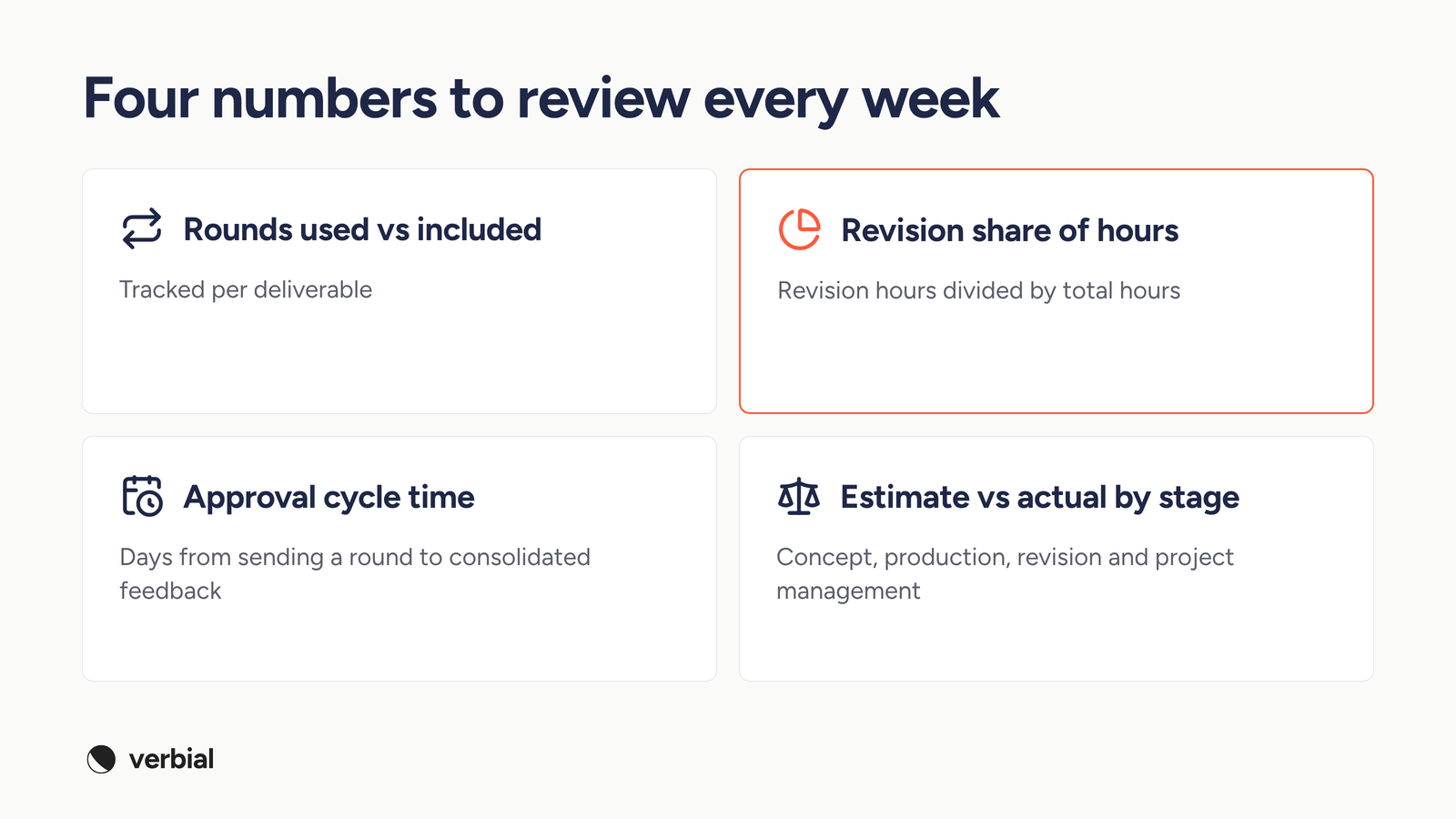
- Rounds used vs rounds included. Track it per deliverable. A job at round three of two is a commercial conversation, not a production problem.
- Revision share of hours. Revision hours divided by total hours. Watch the trend by client. One client consistently above the rest is a pricing or relationship issue.
- Approval cycle time. The days between sending a round and receiving consolidated feedback. Filestage's agency respondents averaged seven days to approval, so anything well above that should trigger a conversation about the approver.
- Estimate vs actual by stage. Concept, production, revision and project management, side by side. This is the number that improves your next proposal.
On retainers the same leak shows up differently. Extra rounds do not overrun a fixed fee; they quietly push the work delivered above what the client pays for, which creates a servicing gap. Review these four numbers in the same weekly meeting you use for the rest of the portfolio, and keep an eye on utilization for the people doing most of the rework.
Who owns creative project management in a 10 to 200 person agency
Ownership tends to shift as an agency grows. A common pattern:
- Under about 20 people. An account manager or a producer who also runs projects. The creative director owns the internal review, and the founder often still signs off on estimates.
- About 20 to 80 people. Dedicated producers or project managers per team or pod. An operations lead owns the estimating library, time codes and the weekly review.
- About 80 to 200 people. A creative operations or traffic function that schedules work across teams, a resource manager who balances capacity, and finance that closes each job against its estimate.
Whatever the size, someone needs to own the commercial side of each creative job, not just the delivery dates. If that role is fuzzy, our marketing agency org chart guide shows how other agencies draw the lines.
Creative project management software for agencies in 2027
Most creative agencies end up with three layers: a place to review the work, a place to move the tasks, and a place where the hours meet the money. These are the tools worth shortlisting.
1. Verbial
Verbial is comprehensive agency management software built for marketing agencies. It connects CRM, proposals, time tracking, invoicing, client reporting and profitability. For creative work, the relevant pieces are projects with budgets and alerts, time tracking tagged to client and department with weekly approvals, and profitability by client, project, department and person while the month is still running. That is where extra rounds turn into visible hours and margin, rather than a surprise at month end. Client sharing is free, with no login or seat needed. Verbial is not a proofing tool, so most creative teams pair it with one of the review tools below.
Best for: agencies that want budgets, time and margin for every creative job in one system.
2. Ziflow
Ziflow is online proofing software for reviewing and approving content, with automated review workflows and support for a wide range of file types.
Best for: studios and in-house style teams with high volumes of static and video proofs.
3. Filestage
Filestage is online proofing software for review and approval, built for creative and marketing teams.
Best for: agencies that need a structured review process with clients who sit in several departments.
4. Frame.io
Frame.io centralizes files, feedback and people for video and creative review, and is part of Adobe.
Best for: video-heavy agencies working in Adobe tools.
5. Teamwork.com or Productive.io
Teamwork.com and Productive.io are both built for client services, with project management, resourcing and profitability features. Teamwork also has a Proofs feature for gathering feedback on creative files. If you are comparing them, see our Teamwork alternative page and our Productive.io vs Verbial comparison.
Best for: agencies that want task-level project management and resourcing in a single platform.
6. Asana or monday.com
Asana and monday.com are general work management tools. They handle task boards, content calendars and production workflows well, but they do not know what a round costs.
Best for: production task management alongside a separate system for time and money.
How to choose
Start from the leak, not the feature list. If approvals are slow and messy, fix review first with a proofing tool. If jobs ship on time but margins keep slipping, the gap is between hours and money, which is what agency management software is for. Many agencies that move off a task-only setup also look at our agency workflow guide to map which tool owns which step.
Common creative project management mistakes
- Starting without a signed-off brief. Every round after that is a debate about what the job was.
- Pricing two rounds and delivering five. Use your actual history when you estimate.
- Accepting feedback from everyone. Unconsolidated comments are not a round.
- Hiding revision time inside production. You cannot fix what you cannot see.
- Calling a new direction "feedback". After concept sign-off, a new direction is a change order.
- Closing jobs without a post-mortem. The estimate library only improves if actuals go back into it.
- Onboarding clients without explaining the process. Set the rules on rounds and approvers during client onboarding, before the first deliverable.
The short version
Creative project management in an agency is ordinary project management plus one thing: control of the review loop. Brief every job, price rounds in the proposal and price the next one, take feedback from one named approver, log revision time separately and treat a new direction as new scope. Then watch four numbers every week: rounds used, revision share, approval cycle time and estimate vs actual. Do that, and the fifth round stops being a surprise and becomes a line on an invoice.
Common questions
What is creative project management?
Creative project management is the practice of planning, producing, reviewing and approving creative work, such as campaigns, video, design and copy, so it lands on brief, on time and at the margin it was sold for. In an agency, the hardest part is the review loop: the client judges the work, the plan repeats through revision rounds, and each extra round costs hours that are easy to miss.
What does a creative project manager do at an agency?
A creative project manager, often called a producer, turns the brief into an estimate and a schedule, runs internal and client reviews, consolidates feedback into rounds, protects the team's capacity and flags when a job moves beyond what was sold. In smaller agencies, an account manager often covers the role.
How many revision rounds should a creative proposal include?
Include the number of rounds you can deliver profitably at the price, base it on your own history for that type of deliverable, and state what an extra round costs. Industry research suggests many jobs need more rounds than agencies plan for: the BetterIdeas Project found an average of five rounds of creative development to reach a signed-off idea.
How is creative project management different from traditional project management?
Traditional project management follows a fairly linear plan of tasks and dependencies. Creative project management has to plan for loops, because work goes back and forth through reviews until it is approved, and for subjective judgement from approvers outside the team. That is why agencies plan and price creative work in rounds as well as hours.
What software do agencies use for creative project management?
Most creative agencies combine three types of tool: a proofing tool such as Ziflow, Filestage or Frame.io for review and approval, a task tool such as Asana or monday.com for production, and agency management software such as Verbial for budgets, time tracking and profitability by client and project.
Written by Alex Borden. Filed under Operations, Profitability.