
On this page
- What is agency project management?
- Why the billing model decides how you manage the project
- 1. Drawdown retainer: pace hours against the calendar
- 2. Fixed monthly fee: watch the servicing gap
- 3. Hourly: approve time weekly and lock the period
- 4. Project or deposit: compare budget burn with percent complete
- 5. Media pass-through: keep spend out of revenue
- The agency project lifecycle, in five stages
- Stage 1: Sell and scope
- Stage 2: Plan and staff
- Stage 3: Kick off and onboard
- Stage 4: Deliver and control
- Stage 5: Close, bill and learn
- How to handle scope changes without losing the client or the margin
- The weekly project review: 20 minutes, four numbers
- Agency project management software: the main options in 2027
- 1. Verbial
- 2. Teamwork.com
- 3. Productive.io
- 4. Asana or monday.com
- 5. Workamajig or Accelo
- How to choose
- Common agency project management mistakes
- The short version
- Common questions
Agency project management is not in-house project management with clients attached. Every agency project carries a billing model, and that model decides what "on track" means. Pace retainers against the calendar, watch the servicing gap on fixed fees, approve hours weekly on hourly work, price every change on fixed-price projects and keep media spend out of revenue. Review all of it in one 20-minute meeting each week.
Most guides to agency project management start with methodologies: agile or waterfall, Kanban or Gantt. Those choices matter less than people think. Two projects can run on the same board, with the same tasks and the same deadline, and one can make 40 percent margin while the other loses money. The difference is almost never the board. It is how the project is billed, and whether the person running it can see the money while the work is still happening.
This guide is for agency owners and operators running teams of roughly 10 to 200 people. It covers what makes agency project management different, the five billing models and the control rule each one needs, how to handle scope changes, a weekly review you can run in 20 minutes, and the software options worth looking at in 2027.
What is agency project management?
Agency project management is the practice of planning, staffing, delivering and closing client work so that it lands on time, within scope and at the margin the agency priced it for. The last part is what separates it from project management inside a company.
An in-house team measures a project by whether it shipped. An agency has to measure two things at once: whether the client got what they paid for, and whether the agency kept what it expected to keep. A campaign that delivers every asset on time but burns 140 percent of the budgeted hours is a delivery success and a commercial failure.
That is why agency project management sits between three jobs that are often split across different people and tools:
- Delivery: tasks, deadlines, owners and the work itself.
- Commercials: the contract, the budget, the billing model and any change orders.
- Capacity: who is free to do the work next week, and who is already stretched.
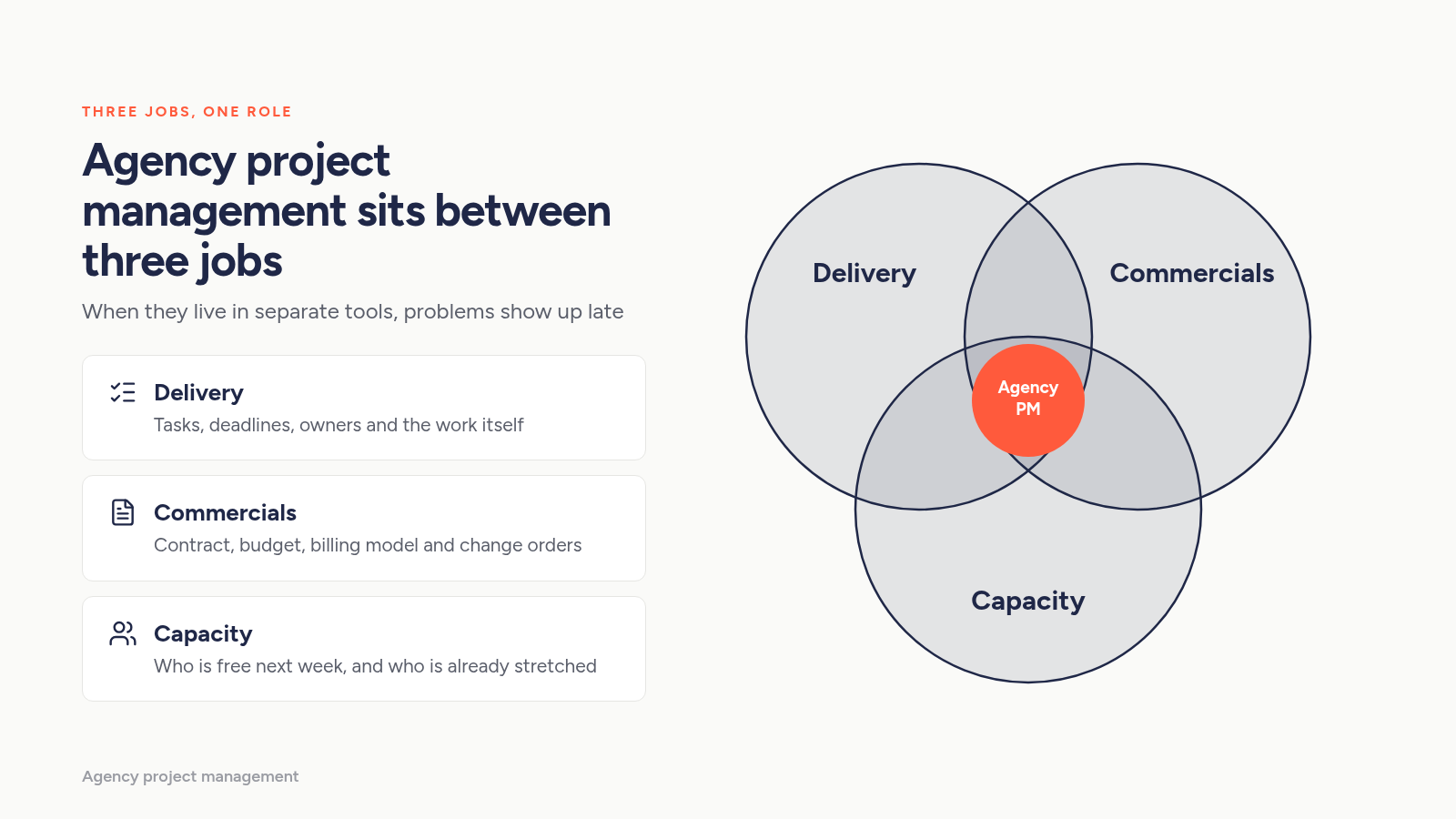
When those three live in separate tools, the project manager sees tasks, finance sees invoices and nobody sees the gap between them until month end.
Why the billing model decides how you manage the project
Here is the idea most agency project management advice skips. The way a client pays changes what "on track" means. A retainer that has used 70 percent of its hours is healthy on day 25 of the month and in trouble on day 10. A fixed-price build at 70 percent of budget is fine if the work is 75 percent done and a problem if it is 40 percent done.
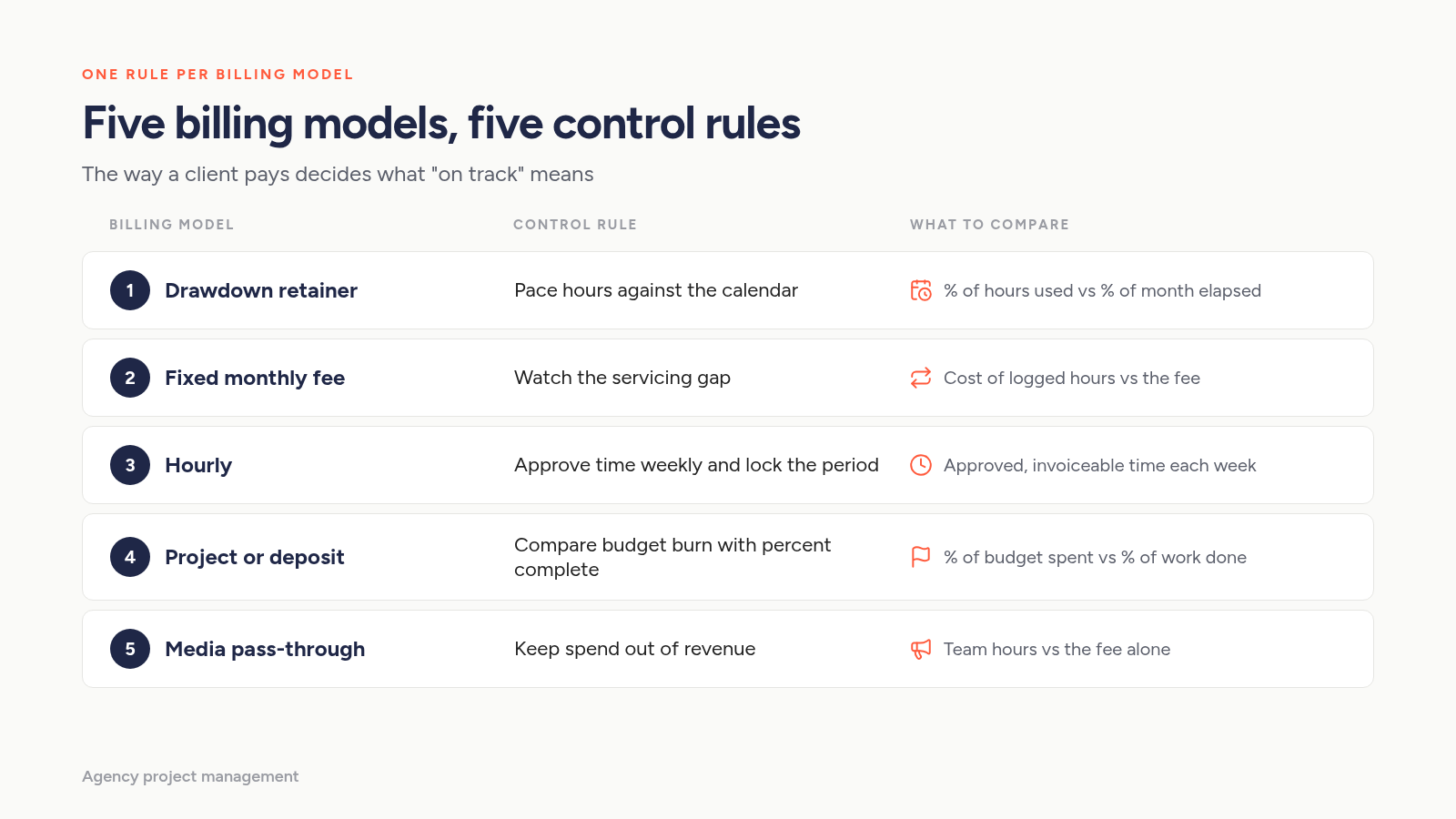
If your team runs every project with the same status colors, you will miss problems on some projects and raise false alarms on others. The fix is to give each billing model its own control rule.
In Verbial, every project is set up on one of five billing types, and a single client can hold projects of different types. Those five map neatly onto the five control rules below.
1. Drawdown retainer: pace hours against the calendar
A drawdown retainer is a fixed monthly amount the team draws down against. The question is not "how many hours are left?" but "are we using them at the right speed?"
Control rule: compare the percentage of hours used with the percentage of the month elapsed. If hours used run well ahead of the calendar, someone needs to decide now whether to slow down, re-sequence or raise an overage, not on the last Friday of the month. Track this as your retainer burn rate, and split it by department when one team is eating the whole allocation.
2. Fixed monthly fee: watch the servicing gap
On a fixed monthly fee the client pays a flat amount for an agreed scope, and hours are tracked but never billed. This is where margin disappears quietly, because there is no invoice line to flag the extra work.
Control rule: log every hour anyway, then compare the cost of those hours with the fee. The difference between what the client pays for and what they actually receive is your servicing gap. Review it monthly and bring it to the renewal conversation with evidence.
3. Hourly: approve time weekly and lock the period
Hourly projects bill logged hours at each person's rate. The risk is not overrun, since the client pays for every hour. The risk is hours that never get logged, get logged to the wrong client or get disputed months later.
Control rule: approve timesheets every week and lock past periods, so the invoice is built from time you can defend. Hours that never reach an invoice are unbilled work, and on hourly projects that is pure lost revenue.
4. Project or deposit: compare budget burn with percent complete
Fixed-price projects, often with a deposit up front, are the closest thing an agency has to classic project management. They are also where scope creep does the most damage, because every unpriced change comes straight out of margin.
Control rule: at every review, compare the share of the budget spent with the share of the work done. If burn runs ahead of progress, the estimate was wrong or the scope has grown. Either way, the project manager needs to say so while there is still budget to protect.
5. Media pass-through: keep spend out of revenue
When ad or influencer spend is billed through with a management fee, the project can look huge on paper. Most of that money is not yours.
Control rule: track pass-through costs separately from the fee, and measure the team's hours against the fee alone. Otherwise a project that moves a large media budget can hide a team that is badly over-servicing it.
The agency project lifecycle, in five stages
Once each project has the right control rule, the lifecycle itself is familiar. What changes in an agency is where the risk sits at each stage.
Stage 1: Sell and scope
The project starts in the proposal, not at kickoff. The scope the client approves should name deliverables, exclusions, the billing model and how changes will be priced. A vague scope is a promise to argue later. If the proposal and the project live in different tools, rebuild nothing by hand. Carry the approved scope and budget straight into the project.
Stage 2: Plan and staff
Turn the scope into a budget in hours or dollars, then book named people against it. Check capacity before you commit dates. A plan that assumes people are free when they are already booked on two other accounts is just a wish. Our guide to agency capacity planning covers how to build that view week by week.
Stage 3: Kick off and onboard
The first two weeks set the tone for the whole engagement. Confirm owners, access, approval rules and the reporting cadence in writing. A clean client onboarding process prevents the most common early overrun: weeks of unplanned back and forth before real work starts.
Stage 4: Deliver and control
This is where the control rules above earn their keep. Run the weekly review described below, route every request outside scope through a change process and keep the client informed with a short, regular update instead of ad hoc emails. For design, video and content work, where most overruns hide in review rounds, see our guide to creative project management.
Stage 5: Close, bill and learn
Close the project formally. Bill any remaining balance, confirm the client accepted the final deliverables and compare estimated hours with actual hours by role. That comparison is the single best input to your next estimate. If you want the numbers behind this stage, see our guide to project accounting for marketing agencies.
How to handle scope changes without losing the client or the margin
Scope creep is not an agency-only problem. In PMI's 2018 Pulse of the Profession survey, 52 percent of projects completed in the prior 12 months experienced scope creep or uncontrolled changes, up from 43 percent five years earlier. In PMI's 2023 edition, organizations that prioritized power skills such as communication still saw 28 percent of their projects experience scope creep. Even the best-run teams live with it. The goal is to make it visible and priced, not to pretend it will stop.
A simple change process that works in most agencies:
- Log the request. Every ask outside the agreed scope gets written down, even small ones. Small ones add up fastest.
- Size it in hours. The project manager estimates the effort by role before anyone starts.
- Choose the route. Absorb it on purpose, swap it for something already in scope, or quote it as extra work.
- Get a yes in writing. A one-line email approval is enough. A verbal "sure, go ahead" is not.
- Update the budget. Add the approved hours or fee to the project so burn and progress stay comparable.
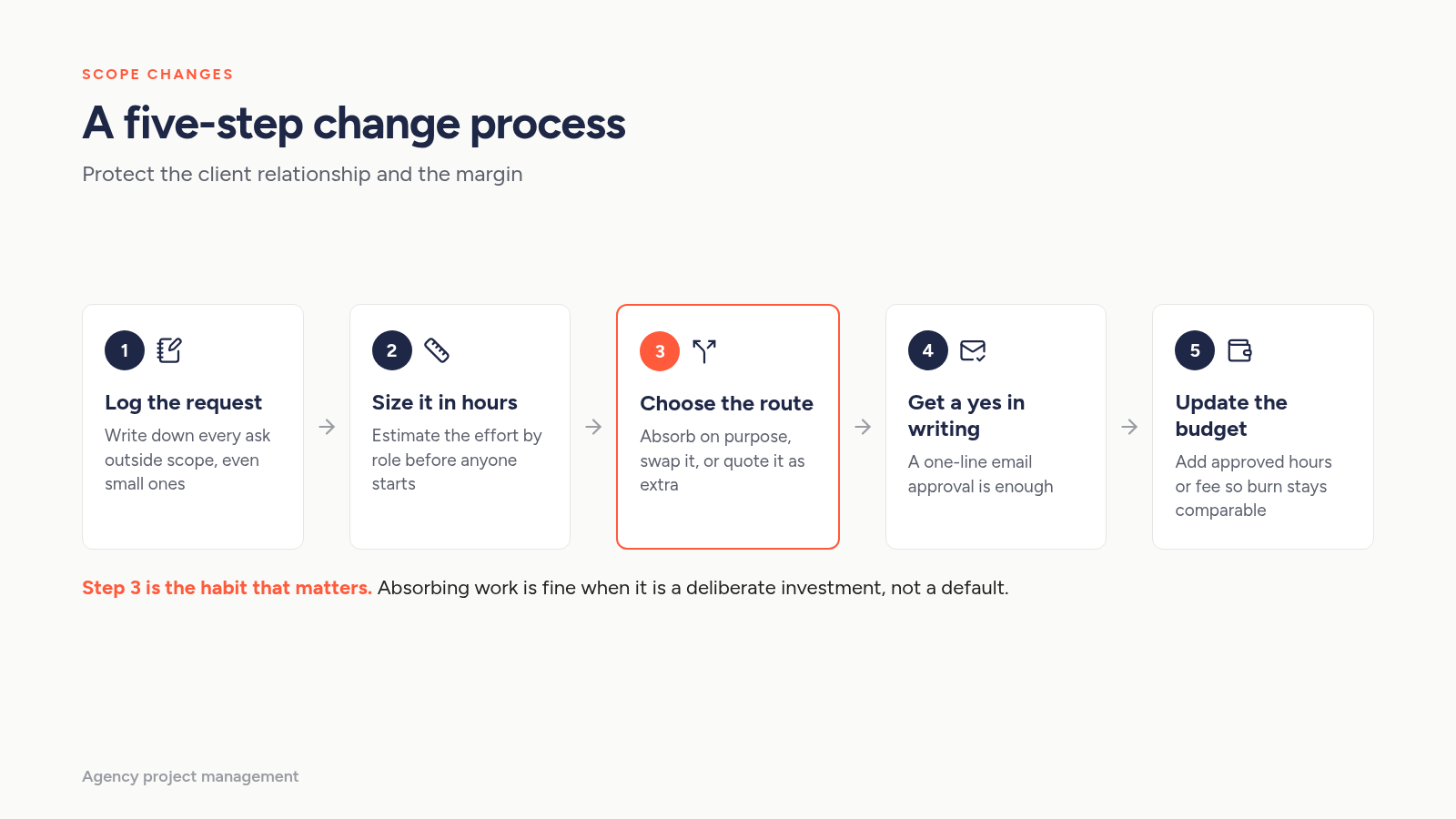
The important habit is step 3. Absorbing work is fine when it is a deliberate investment in the relationship. It is a problem when it happens by default because nobody noticed.
The weekly project review: 20 minutes, four numbers
Agency project management fails most often between status meetings, not during them. A short weekly review with the same four numbers for every active project catches issues while there is still time to act.
For each project, look at:
- Burn against plan. Hours or budget used, read against the right benchmark for its billing model: calendar for retainers, percent complete for fixed-price work.
- Open changes. Requests logged but not yet priced or approved.
- Unapproved or missing time. Hours that should exist but have not been logged or approved.
- Next week's staffing. Whether the people booked on the project actually have room.
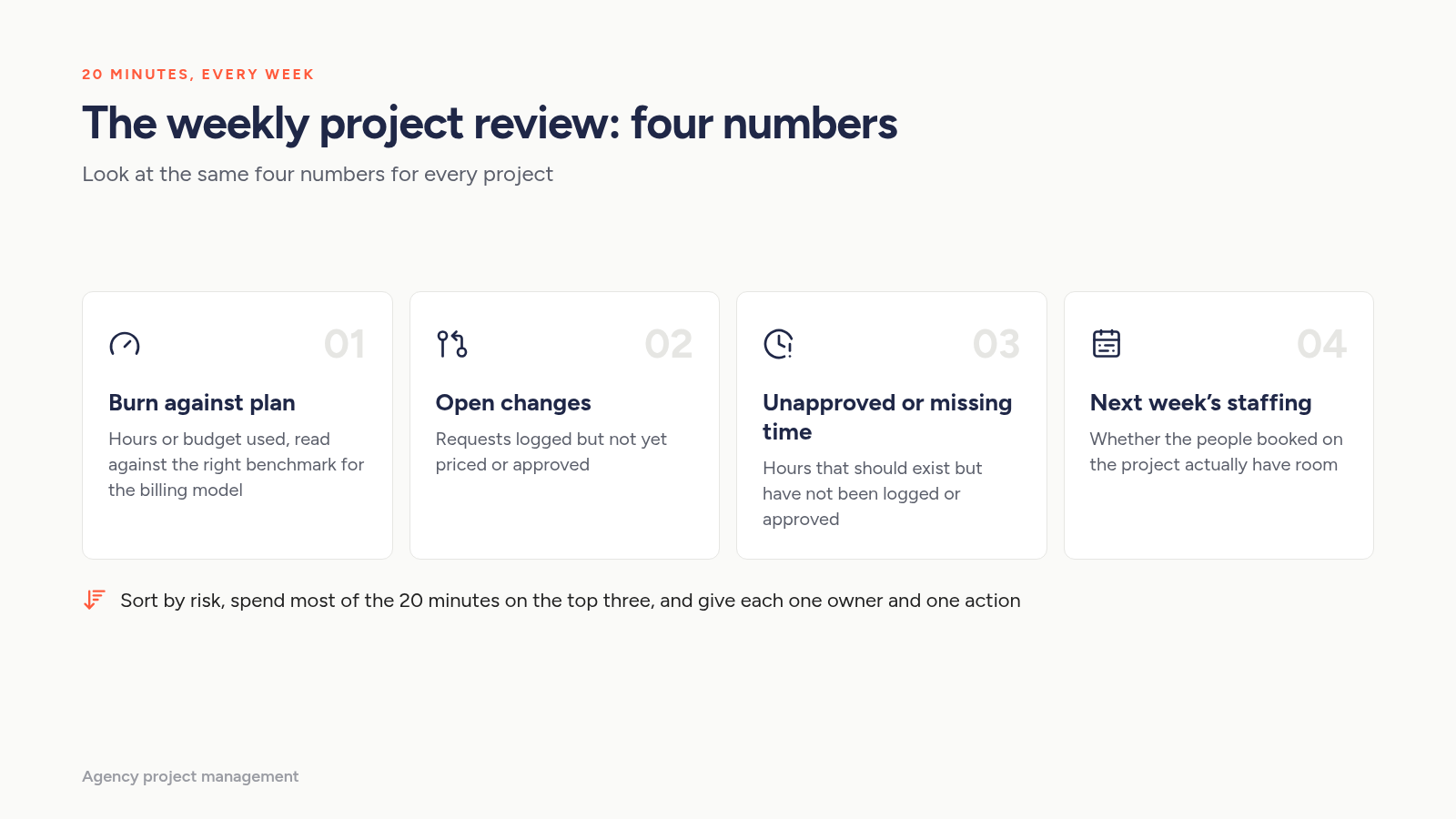
Sort the list by risk, spend most of the 20 minutes on the top three projects and assign one owner and one action to each. Keep the meeting to people who can make decisions. The task-level detail belongs in the project tool, not in the review.
If your team already reviews utilization weekly, fold this into the same slot. Our guide to agency utilization rate includes a routine that pairs well with it.
Agency project management software: the main options in 2027
There is no single right tool. The right choice depends on whether your pain is delivery scheduling or the connection between delivery and money. Here are the main options agency owners shortlist.
1. Verbial
Verbial is comprehensive agency management software built for marketing agencies. It connects the CRM, proposals, time tracking, invoicing, client reporting and profitability, so a won deal becomes the client and project your team tracks time against. Projects carry a billing type and a budget, time is tracked against that scope, and a warning appears when a client reaches 85 percent of its allocation with days left in the month. Projects and tasks are deliberately kept simple, so margin follows the work.
Best for: agencies on retainers and mixed billing models that want project status and margin in one record.
2. Teamwork.com
Teamwork.com is project management built with client work in mind. It is strong on boards, Gantt charts, dependencies, workload and automations, and lets client users collaborate on projects directly. See our Teamwork comparison for where it stops.
Best for: agencies where delivery scheduling across complex, dependent tasks is the main pain.
3. Productive.io
Productive.io is an agency management platform that covers projects, budgets, resourcing and billing. Our Productive.io vs Verbial comparison explains the differences in how each measures profitability.
Best for: agencies that want delivery and resourcing depth in an agency-specific tool.
4. Asana or monday.com
Asana and monday.com are general work management tools that many agencies already use for tasks and content calendars. They are flexible and familiar but not built around retainers, billing models or agency margin, so the commercial side usually lives somewhere else.
Best for: teams whose main need is task coordination, with billing handled separately.
5. Workamajig or Accelo
These are long-established platforms for agencies and professional services firms, and they tend to come up when larger or more process-heavy shops review their stack. If you are comparing them, read our roundups of Workamajig competitors and Accelo alternatives.
Best for: larger agencies that want a traditional agency ERP-style setup.
How to choose
Ask one question first: when a project goes wrong in your agency, do you find out from the task board or from the invoice? If it is the task board, your gap is delivery and a scheduling-heavy tool may help. If it is the invoice, your gap is the link between hours and money, and a tool that ties projects to billing will help more. Many agencies keep a task tool for detailed production work and move the project budget, time and billing into one system. Our agency workflow guide shows where those handoffs usually break.
Common agency project management mistakes
- One status color for every project. Green should mean something different on a retainer and on a fixed-price build.
- Tracking time only on hourly work. Fixed fees are where unlogged hours hide the most margin.
- Approving changes verbally. If it is not written down, it will not be billed.
- Staffing on dates, not capacity. A deadline someone cannot meet is a risk you accepted at kickoff.
- Skipping the closeout. Without estimate versus actual by role, your next quote repeats the same mistake.
- Letting media spend inflate the project. Measure the team against the fee, not the total billed.
The short version
Agency project management works when every project has a control rule that matches how it is billed, every change is priced on purpose and one short weekly review shows burn, changes, missing time and staffing for every active project. Pick tools after you know where your problems actually show up. If the trouble usually appears on the invoice, start by connecting the project to the money.
Common questions
What is agency project management?
Agency project management is planning, staffing, delivering and closing client work so it lands on time, within scope and at the margin it was priced for. Unlike in-house project management, it has to track the client contract and billing model alongside the tasks.
How is agency project management different from in-house project management?
An in-house team mainly measures whether a project shipped. An agency also has to measure whether it kept the margin it priced for, so every project needs a budget, a billing model and a way to price changes, not just a task list and a deadline.
What does an agency project manager do?
An agency project manager turns the approved scope into a plan, books people against it, runs delivery week to week, routes changes through a pricing process and closes the project with a comparison of estimated and actual hours. In smaller agencies the account manager often covers part of this role.
What are the most important metrics in agency project management?
Track budget burn against the right benchmark for each billing model, open change requests, missing or unapproved time and next week's staffing. Over time, add estimate versus actual variance by role and the servicing gap on fixed-fee clients.
Do agencies need separate project management and billing software?
Not necessarily. Many agencies use a task tool for detailed production work and a separate system for time and invoicing, but the gap between them is where margin is lost. Agencies on retainers often benefit from keeping the project budget, time and billing in one system.
Written by Alex Borden. Filed under Operations, Profitability.